The short answer: Ask for the business license. Search the 18-character Unified Social Credit Code on China's official public registry (NECIPS, gsxt.gov.cn, free, no account). Read the business scope. If it says 生产 (produce), 制造 (manufacture), or 加工 (process), the entity is licensed to make things. If it says 贸易 (trade), 批发 (wholesale), 零售 (retail), or 进出口 (import-export), it is a trading company, whatever the booth banner said. Then run the three-way match: license, contract, and bank beneficiary must be the same company, character for character. Everything else in this article is the evidence for why those two minutes matter and the steps that go deeper.
1. The situation
You met a supplier at a fair, or on Alibaba, or through a sourcing agent. Their profile says "manufacturer." Their sales rep says "we are factory." Their booth has product photos, maybe a framed ISO certificate, maybe a wall of machinery shots. You are about to send a deposit of somewhere between a few hundred and a few tens of thousands of dollars to an entity you have never visited, in a country whose legal system you cannot casually use, on the strength of a website and a WhatsApp thread.
One of three things is true:
- They are the factory. The license, the plant, the workers, and the bank account all belong to the same company.
- They are a trading company that is open about it. They find you the product, subcontract the production, manage the order, and take a margin. Some of them are excellent partners.
- They are a trading company pretending to be the factory. They rented a booth, printed a banner, and will route your deposit to an entity you never vetted, subcontracting to a factory you will never know the name of until something goes wrong.
The problem is not the trading company. The problem is that you cannot tell case 1 from case 3 from a laptop, and case 3 is where deposits die. This article is about closing that gap with tools that are free, public, and take about 30 minutes.
2. Why everyone claims to be the factory
The economics of the Chinese export supply chain reward the label "factory" and punish the label "trader," and they have done so for decades. The academic record on this is long and consistent.
Ahn, Khandelwal, and Wei (2011), in one of the most-cited papers on Chinese firm-level trade, documented that intermediaries, firms that facilitate trade without producing, account for a substantial share of China's export transactions, and that their role is largest exactly where information problems are worst: for smaller buyers, more distant markets, and harder-to-standardize goods. Bernard, Grazzi, and Tomas (2011), working with Chinese customs records, measured the intermediary-declared share of exports at roughly 9% for China, near the bottom of their country range. Feenstra and Hanson (2004) traced the same phenomenon back to China's processing-trade regime, where export activity was structurally separated from manufacturing activity. Chen and Li (2014) and Lu, Lu, Sun, and Tao (2017) confirmed the pattern from different angles: intermediary intensity rises for markets that are farther away, smaller, and more regulated.
That last finding matters most for the average buyer of this article. If you are importing into a smaller or more regulated market (the Middle East, Africa, Latin America, Southeast Europe), the intermediary share of what reaches you is higher than the headline customs figure, not lower. The factories closest to your market route through traders. That is not a scandal. It is the system working as designed.
But here is the blind spot, and it is the reason a customs database can never answer your question from the laptop. In Chinese customs data, a trader's subcontracted factory ships under records that can read as a manufacturer. The booth tells the truth the record cannot. Bernard, Grazzi, and Tomasi's customs-based share (around 9%) and the practitioner estimate for fair-booth "factories" (industry estimates commonly run 30 to 50%, with China frequently cited at the upper end for booth-heavy fairs) are measuring two different things, and both are true at once.
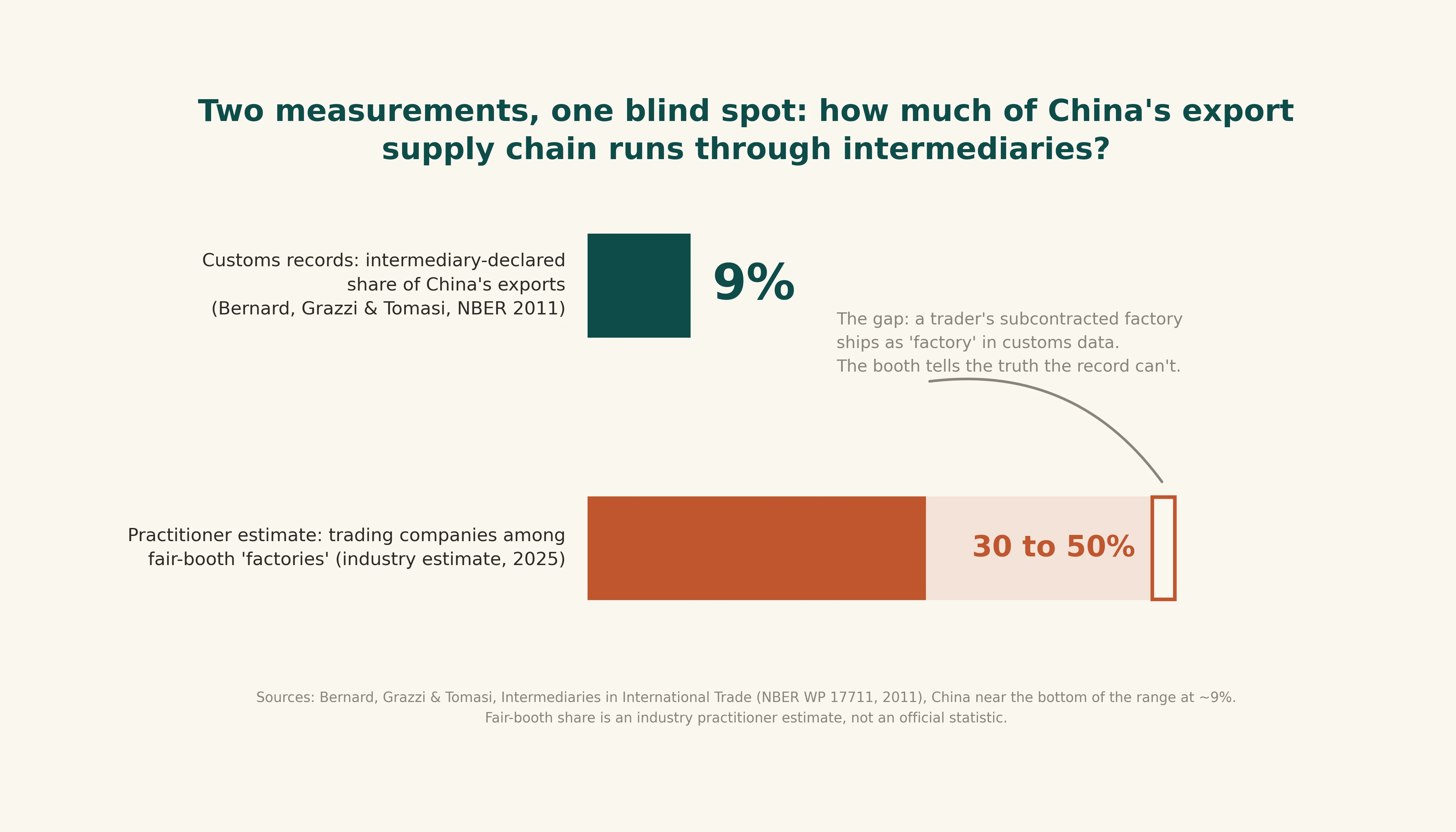
Figure 1. Customs records capture firms that declare intermediary status; the fair booth captures what sellers claim to be. The gap between the two is the undisclosed-trader population this article is about. Sources: Bernard, Grazzi & Tomasi (NBER WP 17711, 2011) for the customs measurement; industry practitioner estimate for booth claims.
Why does the pretense persist? Three reasons:
- Buyers pay a "factory premium" in trust. Western procurement culture treats the factory as the only legitimate counterparty. A trader who admits to being a trader loses deals to one who does not, even when the honest trader would run the order better.
- Margin opacity. "We are the factory" usually means "we will quote you a price that embeds the factory's price plus our margin, with no line item." Disclosure invites price breakdowns.
- Account-hopping. An undisclosed trader can move your next order to whichever factory is cheapest this month, because you have no relationship with the factory. Disclosure would anchor you to one plant and one price.
None of this makes the trader illegitimate. It makes the disclosure asymmetrical: the seller knows what they are, and the buyer pays the cost of finding out.
3. The scale problem: why you cannot pattern-match your way out
There is a second reason laptop verification matters, and it is sheer numbers.
China had roughly 780,000 enterprises with import and export records in 2025, according to the General Administration of Customs of China (GACC), speaking through the State Council Information Office. Against that, the National Bureau of Statistics recorded 25.75 million new business entities registered in 2025 alone, about 26,000 per day, adding to a private-enterprise stock of more than 58 million. A fraction of these are manufacturers in any meaningful sense. The rest are traders, agents, shell registrations, brands, and services.
The fair circuit is the same story in miniature. The 140th Canton Fair (Autumn 2026) hosted more than 32,000 exhibiting enterprises, per the SCIO briefing of September 20, 2026. Exhibitors are roughly 5% of China's foreign trade enterprises, yet the fair's exhibitor base is consistently credited with around 16% of China's general trade exports. In other words, the booths are a curated, concentrated sample of the trading population, not of the manufacturing population, and a large share of the booths at any major fair are held by trading companies representing subcontracted production.
Three consequences follow for the buyer:
- "Big company, must be a factory" fails. Scale of marketing footprint tells you nothing. Some of the largest, most professional Alibaba storefronts belong to ten-person trading companies with excellent English.
- "They have machinery photos" fails. Machinery photos are a shared resource. Trading companies and factories trade photo libraries the same way they trade price lists.
- "They answered every technical question" fails. A good trader knows the product as well as the factory's own sales engineer, because the trader's whole job is standing between you and the factory.
The only reliable discriminator is the legal record, because the legal record is the one document the seller cannot photoshop their way out of. The business license is issued by the state. The registry entry is maintained by the state. The business scope line is drafted by the company and filed with the state, and companies rarely lie on it, because lying on it exposes them to their own regulator, not to you.
4. The 30-minute desk verification ladder
The following routine uses only public tools. Total cost: zero. Total time: about 30 minutes for a first pass.
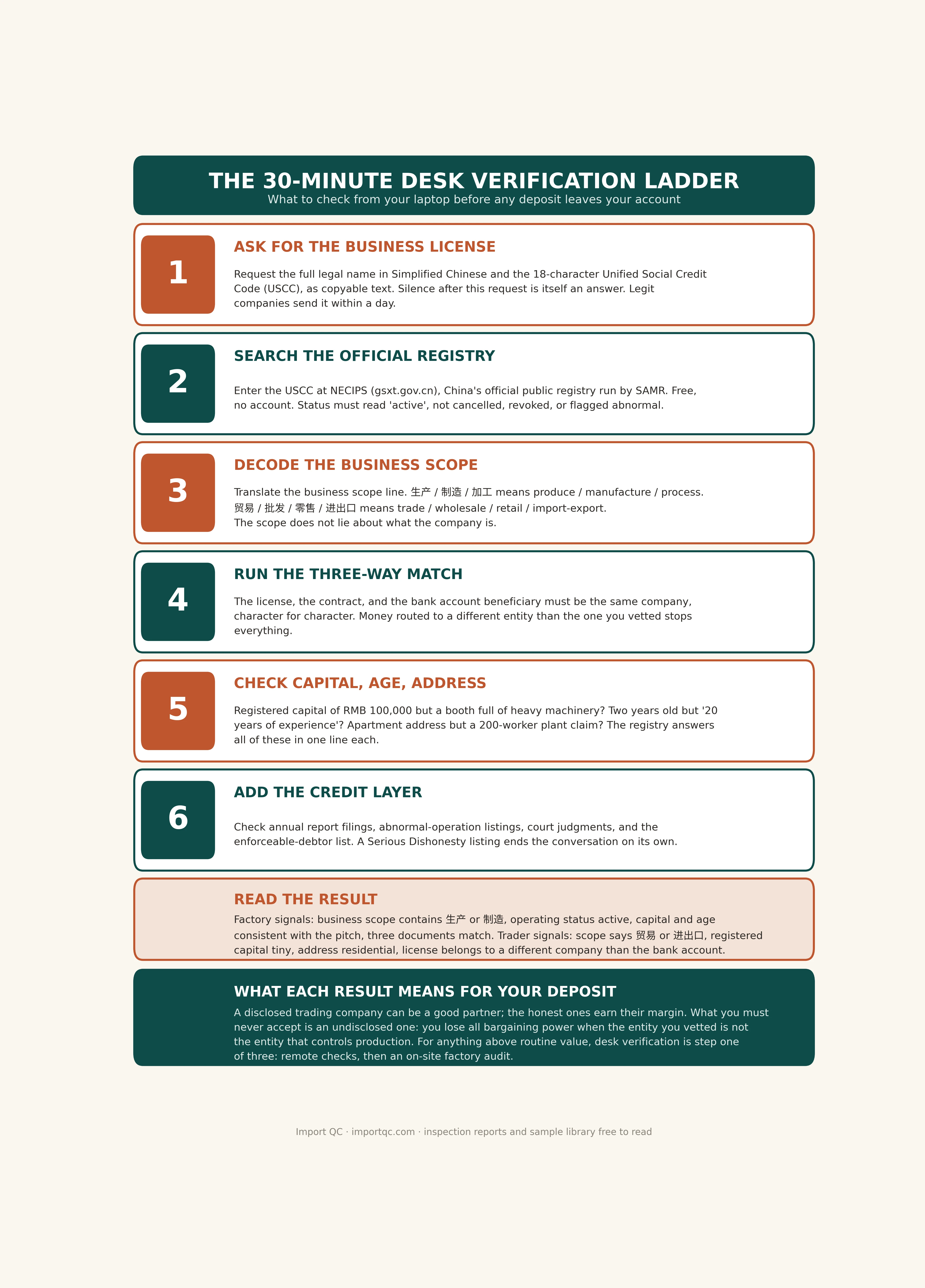
Figure 2. Six steps, in the order that wastes the least of your time. Steps 1 to 3 answer "who is this"; steps 4 to 6 answer "can I trust them with money."
Step 1: Ask for the business license
Request two things as copyable text (not a photo of a business card): the full legal name in Simplified Chinese, and the 18-character Unified Social Credit Code (USCC, 统一社会信用代码). The USCC is the single most useful artifact in Chinese counterparty verification: every registered entity has exactly one, it never changes through name changes, and it is the key to every public database.
Behavioral note: silence after this request is itself an answer. Legitimate companies send the license within a day, often within the hour, because their sales team sends it to every serious prospect as a matter of routine. Evasion ("why do you need that," "our company name in English is enough," a PDF that turns out to be a different company's license) is a finding.
Step 2: Search the official registry
Enter the USCC at NECIPS (gsxt.gov.cn), the National Enterprise Credit Information Publicity System, run by the State Administration for Market Regulation (SAMR). It is free and requires no account. The entry shows: legal name, legal representative, registration status, registered capital, incorporation date, registered address, and the full business scope.
Read the registration status first. It must be 存续 or 在业 (active/existing). Any of the following ends the conversation on its own: 注销 (deregistered), 吊销 (license revoked), or an 经营异常 (abnormal operations) listing, which means the company failed to file annual reports or could not be reached at its registered address.
Step 3: Decode the business scope
The business scope (经营范围) is one long line of standardized phrases. You do not need to read Chinese for the discriminators; you need eight characters.
| Scope contains | Meaning | What it tells you |
|---|---|---|
| 生产 / 制造 / 加工 | produce / manufacture / process | Licensed to make things. Factory signal. |
| 贸易 / 批发 / 零售 / 进出口 | trade / wholesale / retail / import-export | Licensed to sell things. Trader signal. |
| Both | makes some things, trades others | Common and legitimate. Which one are you talking to? |
| 技术服务 / 咨询 / 电子商务 | services / consulting / e-commerce | Not a factory, whatever the booth says. |
Two nuances. First, a scope that contains manufacturing language does not prove the company manufactures your product, only that it is licensed to manufacture something. Second, a scope that contains only trading language is dispositive in the other direction: a company cannot legally operate a production line it is not licensed to describe, and it is not going to file a false scope with SAMR to impress you.
This is the step that resolves trading company vs factory from your laptop. Everything after it is about whether the answer is safe.
Step 4: Run the three-way match
The license, the contract (or proforma invoice), and the bank account beneficiary must be the same legal name, character for character in Chinese. Not "the same group." Not "our Hong Kong office." Not "the boss's other company, faster payment."
A mismatch means the money you vetted is not the money that arrives. Every scam pattern documented in our scam-patterns field guide, and the FBI's BEC statistics ($3.05 billion in reported business email compromise losses in 2025, per the IC3), runs on the gap between the entity you verified and the account you paid. For a cross-border dispute you will never litigate cheaply, the three-way match is the whole game.
Step 5: Check capital, age, and address against the pitch
Registered capital of RMB 100,000 (about $14,000) next to a booth full of injection molding machines? A company incorporated two years ago next to a claim of "20 years of experience"? A registered address in a residential tower next to a "200-worker plant"? The registry answers each of these in one line. None is disqualifying alone; factories restructure, subsidiaries are young, trading addresses are often offices. But the pitch and the record should be reconcilable, and a seller who cannot reconcile them is telling you which one to believe.
Step 6: Add the credit layer
From the same USCC, check: annual report filings (a company that stopped filing is a company that stopped existing in any practical sense), administrative penalties, court judgments, and the enforceable-debtor (Serious Dishonesty) list. A Serious Dishonesty listing, meaning a court has already found this company unwilling to pay a judgment debt, ends the conversation. Not because every listed company will cheat you, but because you are about to become an unsecured creditor in a jurisdiction where their record already says they default.
5. The registry blind spot: a case from our own audit files
Desk verification is necessary. It is not sufficient, and our own case files show exactly why.
In May 2026, Import QC performed a factory audit (report IQC-20260526-AUDIT, available in our sample reports library with company names withheld). The client had vetted the supplier by every step in the ladder above: active registration, consistent capital, clean credit layer, three-way match. The supplier of record passed desk verification.
The audit's first finding, verbatim:
"The supplier of this cooperation is [withheld], but the actual production factory is [withheld]. These two enterprises are long-term partners."
The entity the client vetted was a trading company. It was a well-run one, and the production itself was real: the audited plant was established in 2002, held a valid license through 2052, reported RMB 3.5 million in registered capital and RMB 55 million in annual output, ran a 30,000 m² site with 17,000 m² of production space, equipment averaging under three years old at a roughly 50% operating rate, and held ISO 9001:2015 with on-site and final inspectors keeping verifiable records.
But the audit also documented what desk verification could not: no incoming-material inspection records, no calibration certificates for the measuring equipment, semi-finished and finished goods not segregated, and no operation instructions posted on the line. The client was not just paying a trading margin they had not agreed to. They had zero visibility into the quality system of the plant actually making their order, because the entity they had a relationship with was two degrees removed from the entity running the line.
The remedy in that case was not to cancel the order. It was to restructure it: undisclosed intermediation converted into a disclosed one, with the audit's findings on the production side addressed directly with the real factory, and inspection scope written against the plant rather than the trader. That is the correct general rule, and it brings us to the fairness section.
6. When a trading company is the right answer
Buyers' literature treats "trading company" as a diagnosis. The honest version is more boring: intermediation is a real service with a real price, and for a large class of orders it is the right one.
You are probably better off with a disclosed trading company when:
- Your order is below the factory's minimum. Many plants will not run production under a container-load or a value floor. The trader aggregates yours with nine others and gets the line time you cannot.
- You are buying across many product lines. A factory makes one category. A trader who knows five factories in five categories gives you one counterparty, one shipment, one QC contact.
- Your market is small or heavily certified. Lu et al. (2017) document that intermediary intensity is highest for distant, small, regulated markets, precisely because the fixed costs of compliance and communication are where intermediaries add value.
- Language and time zones are eating you alive. A trader who answers in your language at your hours is selling you a service you would otherwise pay for in mistakes.
The fair deal looks like this: the trader tells you they are a trader, tells you (under NDA if needed) which factory runs your order, quotes a price you can sanity-check, and accepts that your inspection scope covers the production site, not just their office. Many established sourcing agents and trading companies operate exactly this way, and buyers who treat them as respected partners rather than failed factories get better terms and faster problem-solving from them. The sourcing ecosystem runs on these relationships; this article is not an argument against them.
The unfair deal, the one this article exists to kill, is the undisclosed version: the "factory" that is a rented booth, the license that belongs to a different company than the bank account, the plant you will never be allowed to name, let alone visit or inspect. In that structure, every quality problem arrives with two refusals attached: the "factory" refuses responsibility because it subcontracted, and the subcontractor refuses it because you are not its customer.
7. The math of getting it wrong
What does a misidentified counterparty actually cost? Not the worst case, the routine case.
Direct costs, using typical figures for a first order from a new supplier:
- The trading margin you did not agree to. Undisclosed intermediation in consumer goods commonly runs 10 to 30 points on factory price. On a $20,000 order, that is $2,000 to $6,000 of margin you had no chance to negotiate, because you were negotiating with the wrong counterparty's cost base.
- The failure you paid full price for. Our failed-inspection sample from July 2026 (IQC-20260726-TOY, in the sample reports library) documents a 50,000-unit toy order where only one-fifth of the goods were packed at the time of inspection, 14 major and 24 minor defects exceeded AQL limits, two field tests failed, and retail cartons contained the wrong product designs. The buyer's bargaining power in that situation is proportional to how much they know about who actually controls production. The buyer who knows the factory can stop the line. The buyer who knows only a "sales company" can send emails.
- The compliance exposure that lands on your name. The EU's Safety Gate system (formerly RAPEX) logged a record 4,671 alerts in 2025, up 13% on 2024 and the highest since the system launched in 2003, with cosmetics at 36% of alerts, toys at 16%, and electrical goods at 11%. Across the full 2005 to 2025 record, 44,529 alerts, China appears as the country of origin in 51% of them (22,728 alerts), and roughly 85% of dangerous toys and electrical goods alerts. Your customs broker and your market's regulator will not accept "the trading company handled it" as a defense. The importer of record is you.
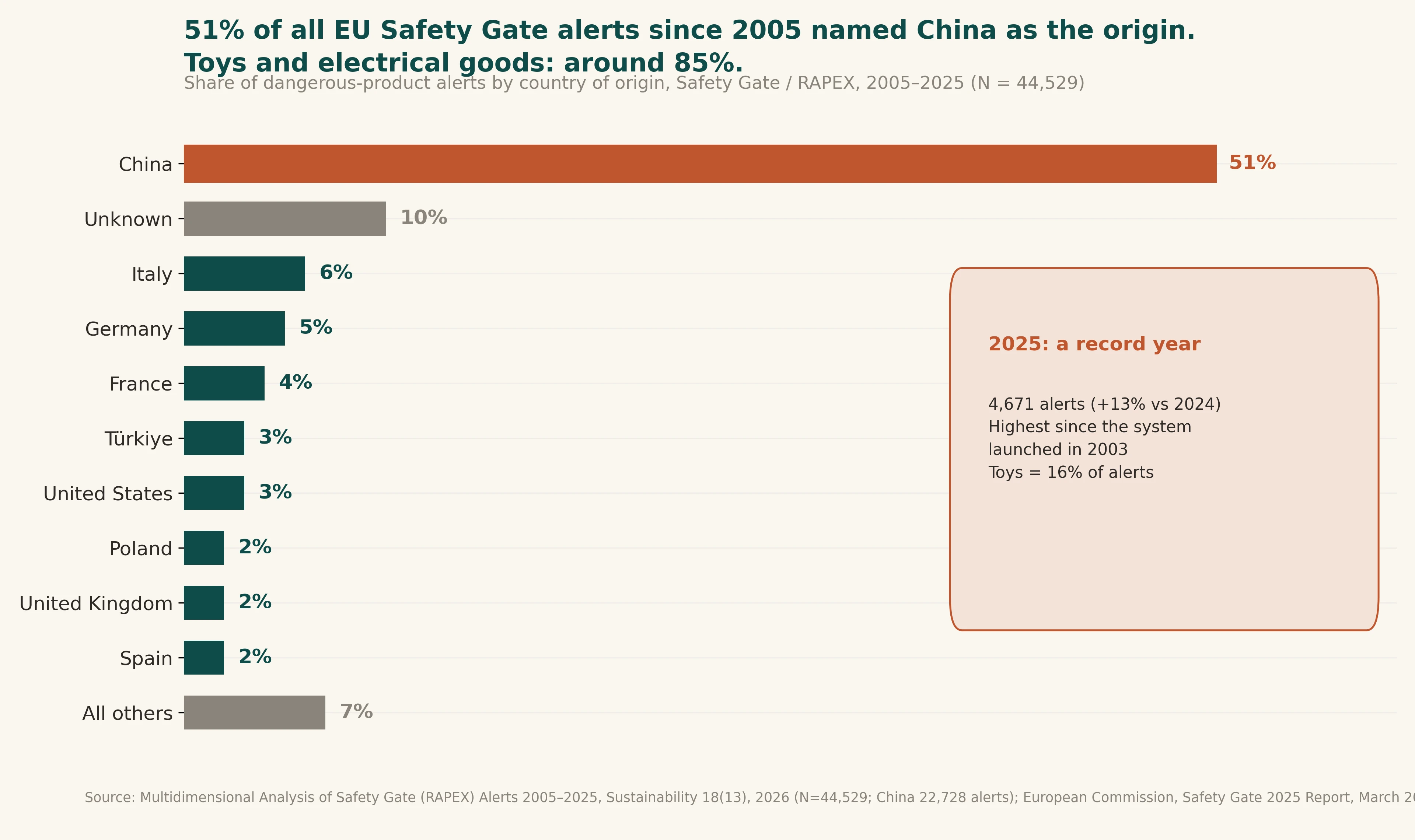
Figure 3. Share of dangerous-product alerts by country of origin, Safety Gate / RAPEX, 2005-2025 (N = 44,529). Source: Multidimensional Analysis of Safety Gate (RAPEX) Alerts 2005-2025, Sustainability 18(13), 2026; European Commission, Safety Gate 2025 Report.
Add the tail risks and the arithmetic gets one-sided. The FBI's IC3 recorded $3.05 billion in reported BEC losses in 2025, and the single most common mechanism is payment redirected to an account belonging to an entity the buyer never vetted: exactly the gap the three-way match closes. For the routine case and the tail case alike, the cost of the 30 minutes described above is a rounding error next to the cost of skipping it.
8. Where desk verification ends and feet-on-site begins
The ladder answers "who is this company" and "should I send money." It cannot answer "can this site make my order to spec," because that question is physical: machines, material staging, operator instructions, calibration stickers, segregated lots. That is the boundary where remote verification ends and third-party inspection in China begins, on a flat $149 per man-day, with an inspector dispatched to the actual production site within 48 to 72 hours and a photo-documented report inside 24 hours of the visit. The sample reports library shows what that looks like in practice: PSI reports, DUPRO reports, and factory audits, including the audit quoted in section 5, free to read.
The sequence that protects a first order is three layers deep: desk verification (this article, free, 30 minutes), then an on-site factory audit before the deposit for anything above routine value, then pre-shipment inspection on the finished goods before the balance payment. Buyers who run all three rarely need the fourth layer, which is lawyers.
FAQ
Is a trading company always bad? No. Disclosed trading companies provide aggregation, communication, and compliance services that many factories cannot or will not provide. The objection is to undisclosed intermediation, not to intermediation.
The supplier sent a license, but the name doesn't match the website. Is that a red flag? Not by itself: English trade names almost never match Chinese legal names. Match the Chinese legal name and USCC across license, contract, and bank account instead. If the website and the license belong to different USCCs, ask why, in writing.
What if the registry shows the company is less than a year old? Newness is a risk amplifier, not a verdict. Young entities fail desk verification more often mainly because they have no filing history, no credit record, and no demonstrated capacity. Compensate with a stricter three-way match and a factory audit before the deposit.
Can a factory also hold an import-export license, and does that make it a trading company? Holding 进出口 (import-export) rights is normal for factories and does not make a manufacturer a trader. The discriminator is whether manufacturing language (生产/制造/加工) appears in the scope at all. A factory with export rights has both; a trader has only the trading side.
What if the supplier refuses to give the USCC? Treat it as a failed Step 1. Legitimate suppliers part with this information routinely. There is no legitimate reason to withhold a USCC from a buyer about to send a deposit.
Does a clean registry entry guarantee the company is honest? No. It guarantees the company exists, is active, and has not already been flagged by its own regulator. Sections 5 and 8 exist precisely because registry-clean companies still subcontract, and the quality question is answered at the production site, not in a database.
How long does the full desk check take? Steps 1 to 3, about 10 minutes of your time spread over a day (most of it is waiting for the license). Steps 4 to 6, another 20 minutes once documents arrive. Budget 30 minutes total across one or two working days.
Is NECIPS available in English? Partially, and erratically. The registry is a Chinese-language system; use browser translation and the eight characters in the table in Step 3, which translate identically regardless of interface language. Third-party enterprise-data platforms mirror the same registry with English front-ends if you prefer, but the underlying record is always the SAMR registry.
I only buy small orders. Is this overkill? Steps 1 to 4 cost nothing and take minutes; run them on every new counterparty regardless of order size. Reserve the audit and inspection layers (section 8) for orders where the deposit would hurt to lose.
Sources
- Ahn, J.-B., Khandelwal, A. K., & Wei, S.-J. (2011). The role of intermediaries in facilitating trade. Journal of International Economics, 84(1), 73-85.
- Bernard, A. B., Grazzi, M., & Tomasi, C. (2011). Intermediaries in International Trade: Margins of trade and export flows. NBER Working Paper 17711. (China intermediary-declared share of exports, ~9%.)
- Chen, X., & Li, J. (2014). Intermediaries and trade: Evidence from Chinese export firms. (China firm-level intermediary evidence.)
- Lu, J., Lu, Y., Sun, T., & Tao, Z. (2017). Intermediation and trade quality: Evidence from China. The World Economy. (Intermediary intensity higher for distant, small, regulated markets.)
- Feenstra, R. C., & Hanson, G. H. (2004). Intermediaries in entrepot trade: Hong Kong re-exports of Chinese goods. Journal of Economics & Management Strategy, 13(1), 3-35.
- General Administration of Customs of China (GACC), via State Council Information Office press briefing: ~780,000 enterprises with import/export records in 2025.
- National Bureau of Statistics of China: 25.75 million new business entities registered in 2025; private-enterprise stock above 58 million.
- State Council Information Office briefing, September 20, 2026: 140th Canton Fair, 32,000+ exhibiting enterprises.
- European Commission, Safety Gate 2025 Report (March 2026): 4,671 alerts in 2025, +13% vs 2024, record since 2003; cosmetics 36%, toys 16%, electrical 11% of alerts.
- Multidimensional Analysis of Safety Gate (RAPEX) Alerts 2005-2025. Sustainability, 18(13), 2026. (N = 44,529 alerts; China 22,728, 51%; ~85% of dangerous toys/electrical alerts.)
- FBI Internet Crime Complaint Center (IC3), 2025 Internet Crime Report: $3.05 billion in reported BEC losses.
- State Administration for Market Regulation: National Enterprise Credit Information Publicity System (gsxt.gov.cn), USCC and business-scope registry mechanics.
- Import QC sample reports library: Factory Audit IQC-20260526-AUDIT (May 26, 2026); PSI report IQC-20260726-TOY (July 26, 2026). Company names withheld in public samples.
- Related reading: Canton Fair 2026: how to verify the 40 suppliers you just met · Scam patterns after Canton Fair season · The anatomy of a failed inspection
Want the on-site layer? Third-party inspection in China at $149 per man-day, inspector dispatched within 48-72 hours, photo-documented report within 24 hours. See the sample reports library for real reports, including the factory audit quoted in section 5, free to read.