
The short answer: A pre-shipment inspection (PSI) runs on a fixed skeleton: six sections, executed in one working day, on a random sample drawn under ANSI/ASQ Z1.4 (the same tables published as ISO 2859-1). Section A records production status and quantity. Section B records packing: cartons, marks, assortment. Section C is workmanship, the defect hunt, with every finding classified critical, major, or minor against your AQL settings. Section D records what happened to the defects found: fixed on site, promised, or not handled. Section E is measurements against your spec sheet. Section F is field tests, a menu of function, safety, and abuse checks matched to the product category. Below is each section, line by line, with real entries from our own reports so you can see what the document looks like when it comes back.
1. The situation
Your order is finished, or the factory says it is. The balance payment (70% under the usual 30/70 split) is due before the goods ship. You cannot fly over. Someone offers to walk the floor for you, and the question sitting in your inbox is a plainer one: "what does this person do all day on site, and what do I get back?"
What you get back is a document. Ours runs about 30 pages for a routine consumer-goods order, more when the product is complex (the sealing-machine report in our sample library runs 69). Every page traces to a checklist. This article is that checklist, line by line.
One number before the lines, because it is the reason the checklist exists. In our defect dataset (twelve recent pre-shipment inspections, 81,071 units across footwear, textiles, electronics, appliances, furniture, toys, and industrial steel), the samples produced 141 defective units. Roughly two-thirds of those were fixed while the inspector was still standing at the line. The checklist is why they were found. The on-site presence is why they were fixed. An order nobody checks ships with both the defects and the silence.
2. The skeleton: six sections, in order
Every PSI report we issue follows the same structure:
- A. Bulk summary: is the order real, finished, and packed?
- B. Packing information: how does it travel?
- C. Workmanship: what is wrong with the units, counted against AQL limits?
- D. Defects disposal: what happened to the defective units?
- E. Product details and measurements: does the product match the spec sheet?
- F. Data measurement / field test: does it work, survive, and scan?
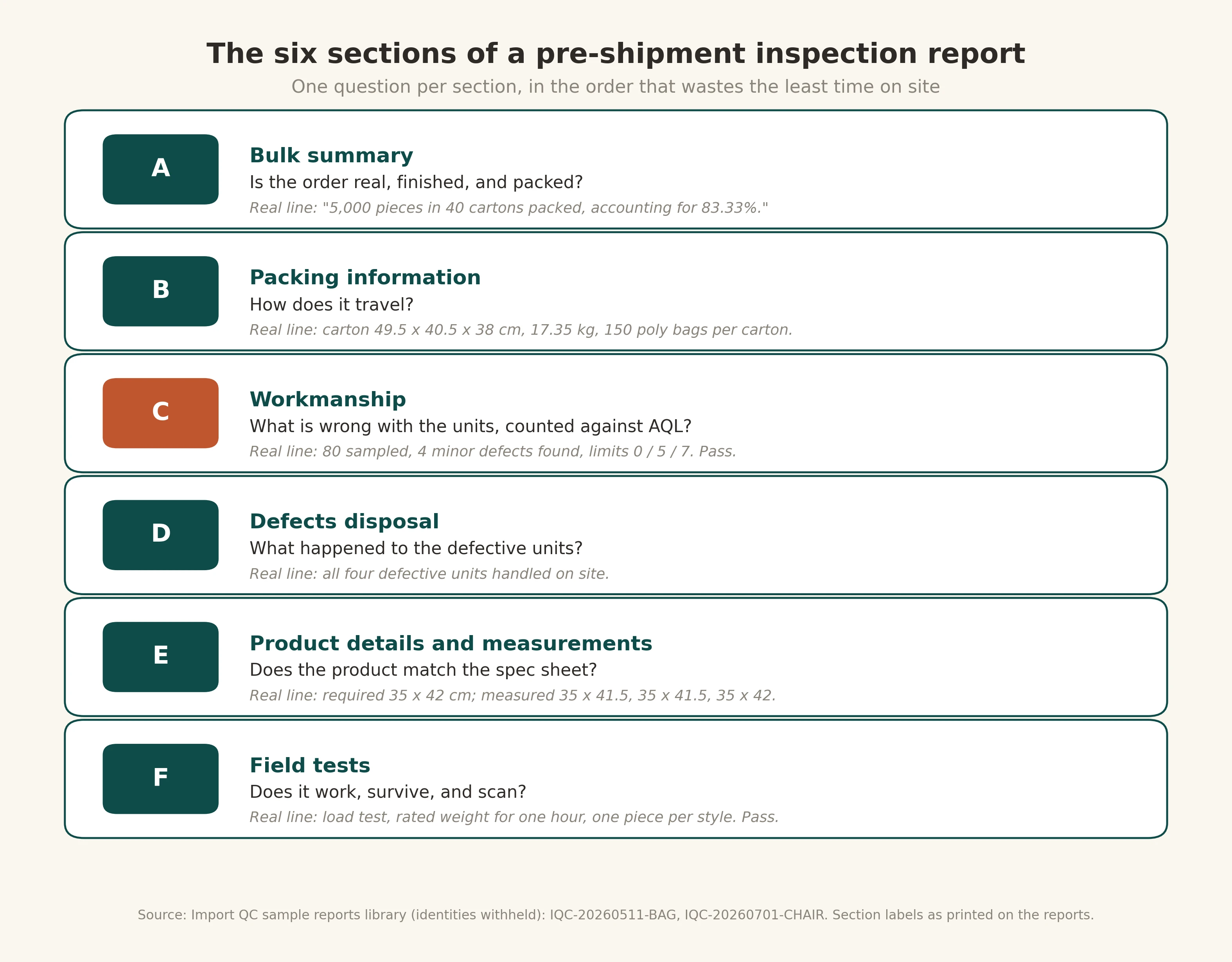
Figure 1. The report skeleton. Each section answers one question, in the order that wastes the least time on site.
The order is deliberate. Quantity comes first because a factory that is 60% packed is telling you something about its schedule. Packing comes next because cartons are closing while the inspector watches. Workmanship runs on the random sample once the cartons are mapped. Disposal, measurements, and tests close the day.
3. Section A: production status and quantity
The first lines of the report answer the most basic commercial question: does the order exist, in full, ready to ship?
The lines:
- Order quantity vs. actual finished quantity. Both numbers, side by side. A gap here is a finding, not a footnote.
- Packed vs. unpacked units, carton count, packing percentage. The inspector counts cartons before opening any of them.
- Inspection type and sampling standard. PSI vs. DUPRO vs. re-inspection, and the AQL plan the report will be judged against.
Real entries, from our drawstring-bag report of May 11, 2026 (IQC-20260511-BAG, in the sample reports library with identities withheld). Order: 6,000 pieces in two item numbers. The brief findings open with:
"All bulk goods have been fully produced. 5,000 pieces in 40 cartons have been packed, accounting for 83.33%. The remaining 1,000 pieces are being packed at the factory."
That line matters more than it looks. The industry convention is to run a PSI when the goods are 100% finished and at least 80% packed, because anything unpacked cannot be checked for packing, and because factories sometimes rush-pack after an inspection and undo what was verified. At 83.33% packed, this inspection cleared the bar by about three percentage points. The report says so, with the arithmetic shown.
The same report carries a second quantity-era finding:
"Only pasted shipping marks label on two cartons. The factory stated that all carton marks will be uniformly attached before shipment."
Two cartons out of 40 had shipping marks. Not a defect of the product, but a fact the buyer needs before authorizing the balance, recorded where it belongs: at the top of the report, not buried.
4. Section B: packing information
Packing lines record how your product survives the next six weeks: container, port, warehouse, courier.
The lines:
- Export carton dimensions and weight, measured, not copied from the PI.
- Units per carton and packing method.
- Shipping marks, labels, barcodes.
- Inner protection: poly bags, dividers, desiccant.
Real entries from the same bag report: carton 49.5 × 40.5 × 38 cm, 17.35 kg gross, and the packing-method line reads "each product is packed into one poly bag, and 150 poly bags are packed into one carton." The office-chair report (IQC-20260701-CHAIR, July 1, 2026) records a 5-ply export carton at 3 chairs per carton, with the carton print photographed: item number, quantity, color, packing size, gross and net weight, country of origin.
These lines look administrative. They are where warehouse rejections and freight claims are prevented or lost. A carton heavier than your fulfillment center's limit, a missing FNSKU, a carton that fails a drop test in section F: all of it lands here first.
And here is the packing line doing something else. From the electric-blanket report (IQC-20260902-BLANKET, September 2, 2026), brief finding 2: the client had provided no shipping marks, packing method, label spec, or measurement data, so the inspection recorded actual findings against no reference. The checklist line did not fail the goods. It recorded that the buyer's side of the paperwork did not exist yet. That distinction, goods bad versus reference missing, is one a factory's own QC sheet will never write down about itself.
5. Section C: workmanship, the core of the day
Workmanship is the section people mean when they say "inspection." It is also the section with the most arithmetic.
How the sample is drawn
The default plan across the industry, and the one printed on our reports, is ANSI/ASQ Z1.4-2008, single sampling plan, General Inspection Level II, with AQL settings of 0 for critical, 2.5 for major, and 4.0 for minor defects unless the buyer specifies otherwise. The lot size gives a code letter, the code letter gives the sample size, and the AQL gives the accept and reject numbers.
| Lot size | Code letter | Sample size | Major 2.5 (accept / reject) | Minor 4.0 (accept / reject) |
|---|---|---|---|---|
| 151-280 | G | 32 | 2 / 3 | 3 / 4 |
| 281-500 | H | 50 | 3 / 4 | 5 / 6 |
| 501-1,200 | J | 80 | 5 / 6 | 7 / 8 |
| 1,201-3,200 | K | 125 | 7 / 8 | 10 / 11 |
| 3,201-10,000 | L | 200 | 10 / 11 | 14 / 15 |
| 10,001-35,000 | M | 315 | 14 / 15 | 21 / 22 |
| 35,001-150,000 | N | 500 | 21 / 22 | 21 / 22 |
Table: ANSI/ASQ Z1.4, single sampling, normal inspection, General Level II. Critical defects: zero accepted at any lot size.
Two of these rows are confirmed by our own paperwork, not just the standard. The chair order was 676 pieces, code letter J, 80 units sampled, and the report prints the acceptance limits next to the defect table: 0 critical, 5 major, 7 minor. The bag order was 6,000 pieces, code letter L, 200 units sampled. The table is the same table the factory's own QC manager reads, which is why the numbers are enforceable in a dispute.
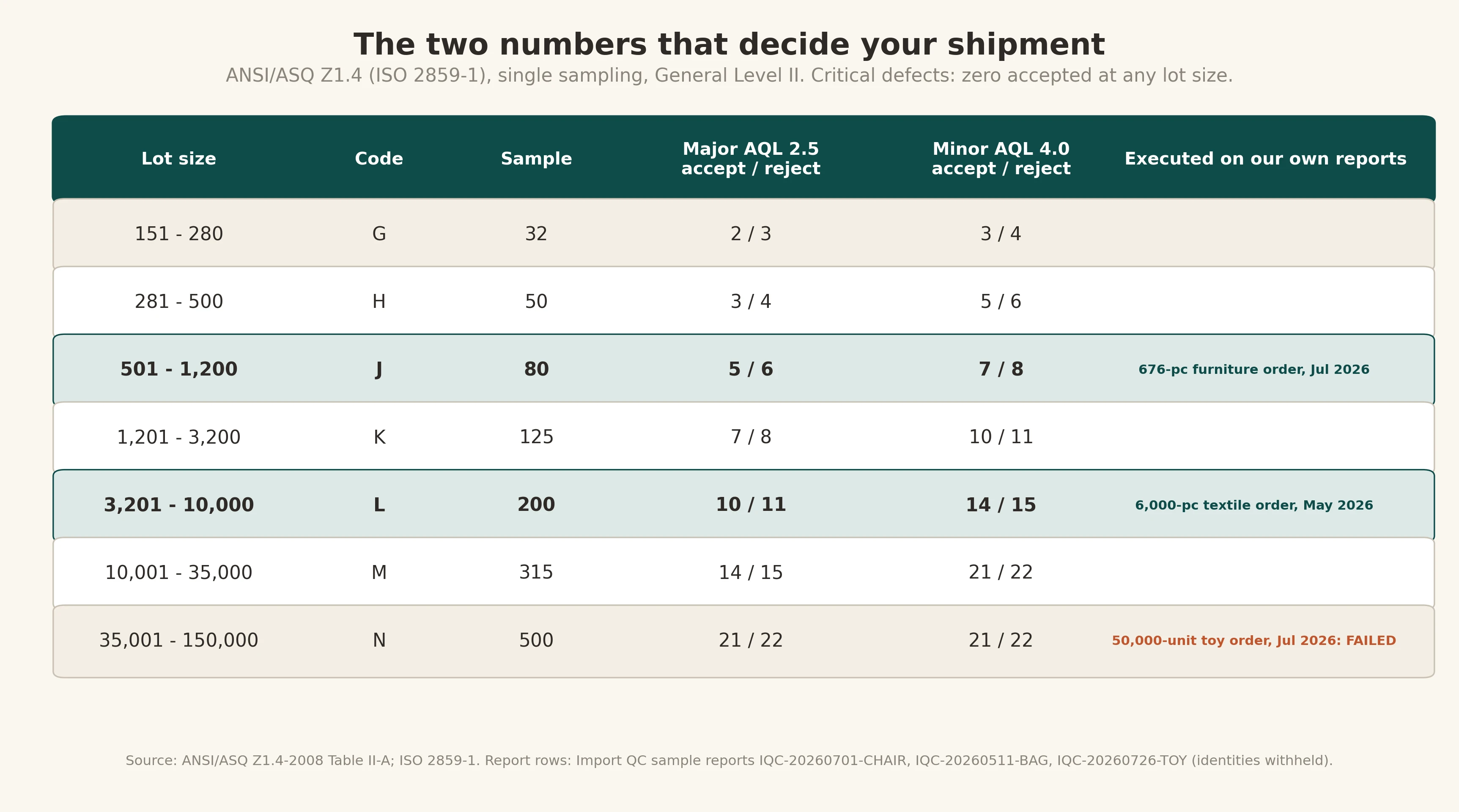
Figure 2. Read down from your lot size to the sample size, then across to the two numbers that decide the shipment. Rows J and L are marked because our own reports (676-piece furniture order, 6,000-piece textile order) executed those two rows. Source: ANSI/ASQ Z1.4-2008 Table II-A; ISO 2859-1.
How the 80 or 200 units are picked matters as much as the count. The inspector selects cartons at random from the full stack, including the bottom, and opens them on the spot. A factory that offers to "pre-select the samples" is offering to grade its own homework. The answer is always no, and the refusal is procedural, not personal.
What the inspector is hunting
Every defect found goes into one of three classes:
- Critical: unsafe or non-compliant. Exposed wiring, sharp edges, a choking hazard. Zero accepted, at any lot size, at any AQL setting. One critical defect fails the lot.
- Major: reduces usability or saleability. A broken zipper, a wrong color, a function that does not work. Default limit AQL 2.5.
- Minor: cosmetic, unlikely to stop a sale. A small scratch, an untrimmed thread. Default limit AQL 4.0.
The chair report's workmanship table, in full, for 80 sampled units across four item numbers: one dirty mark on item 2005B (12 sampled), one untrimmed thread end on 2020A (28 sampled), one dirty mark on 2020B (28 sampled), one dirty mark on 2301A (12 sampled). Four minor defects, zero critical, zero major, against limits of 0 / 5 / 7. Pass, with the arithmetic on the page.
The bag report's workmanship table: 200 sampled, two major (foreign fibres on HPDB05) and six minor (untrimmed thread ends, a dirty mark), a 4% total defect rate, against limits of 0 / 10 / 14. Pass, with less room to spare.
Notice what the tables do not say. Neither says "quality is good." They say: on this sample, under this standard, the defect counts sit inside the agreed limits. That is the honest sentence a checklist can produce, and it is the sentence your balance payment should be conditioned on.
6. Section D: defects disposal
The least known section of the report, and the one that pays for the day.
For every defect found, the disposal table records three columns: handled on site, promise to handle, not handled.
The chair report: all four defective units handled on site. The blanket report: five minor defects found in 80 sampled units, all reworked or replaced before the inspector left. The bag report is the counterexample, and its disposal finding is blunt: "All defective products were not reworked or replaced on site." Same checklist, different factory behavior, both recorded.
Across the twelve-inspection dataset, roughly two-thirds of the 141 defective units found were fixed during the inspection itself: trimmed, wiped, reworked, or replaced while someone watched. This is the part of the economics that never appears in a quote comparison. The industry sells pass and fail. The floor reality is that a large share of defects do not survive the inspection, because factories fix what is being watched. The disposal section is where that value shows up in writing, and it exists only when somebody visits.
7. Section E: product details and measurements
Measurement lines compare the product against your spec sheet, sample by sample. Required versus measured, with the tolerance doing the judging.
From the chair report: required size 60 × 69 × 100-110 cm; measured on sample 1 at 59.2 × 64.5 × 101.5-111 cm; net weight 10.4, 10.5, 10.6 kg across three samples. From the bag report: required 35 × 42 cm; measured 35 × 41.5, 35 × 41.5, 35 × 42; net weight 102.4 to 102.6 g.
Two things to see here. First, the numbers are boring, and boring is the product. A measurement table that matches the spec within tolerance is the whole point; you are paying for the absence of drama. Second, the table is only as strong as the tolerance behind it. "35 × 42 cm" with no tolerance forces an argument about whether 41.5 passes. "35 × 42 cm ± 1 cm" ends the argument before it starts. When a client provides no measurement data at all, as in the blanket report, the inspector records actual findings against no reference, and the report says so. The line degrades gracefully instead of disappearing.
8. Section F: field tests
Field tests are the part of the checklist that changes with the product. The menu is category-matched, and the quantities are deliberate: usually 5 pieces per item for anything that stresses the product, 20 to 32 for electronics checks, and up to the full workmanship sample for function.
Real test menus from three reports:
Office chair (furniture): assembly test (assemble with provided accessories, no failure), function test (per the user manual, on all 80 sampled units), load test (rated weight for one hour, one piece per style), roller test ("check if the wheels of the chair move smoothly without any jerking or sticking"), rub test (ten passes with wet white cotton fabric; no obvious color transfer allowed).
Drawstring bag (softlines): rubbing test, 3M tape test (print and coating adhesion), loading test, tensile test, function test, stitch-density inspection, color check against reference, odor check (no irritating smell allowed).
Electric blanket (appliance): aging test on 32 units, leakage current, odor, carton drop, color fastness, barcode scanning, product temperature, power measurement, controller function, 3M tape test.
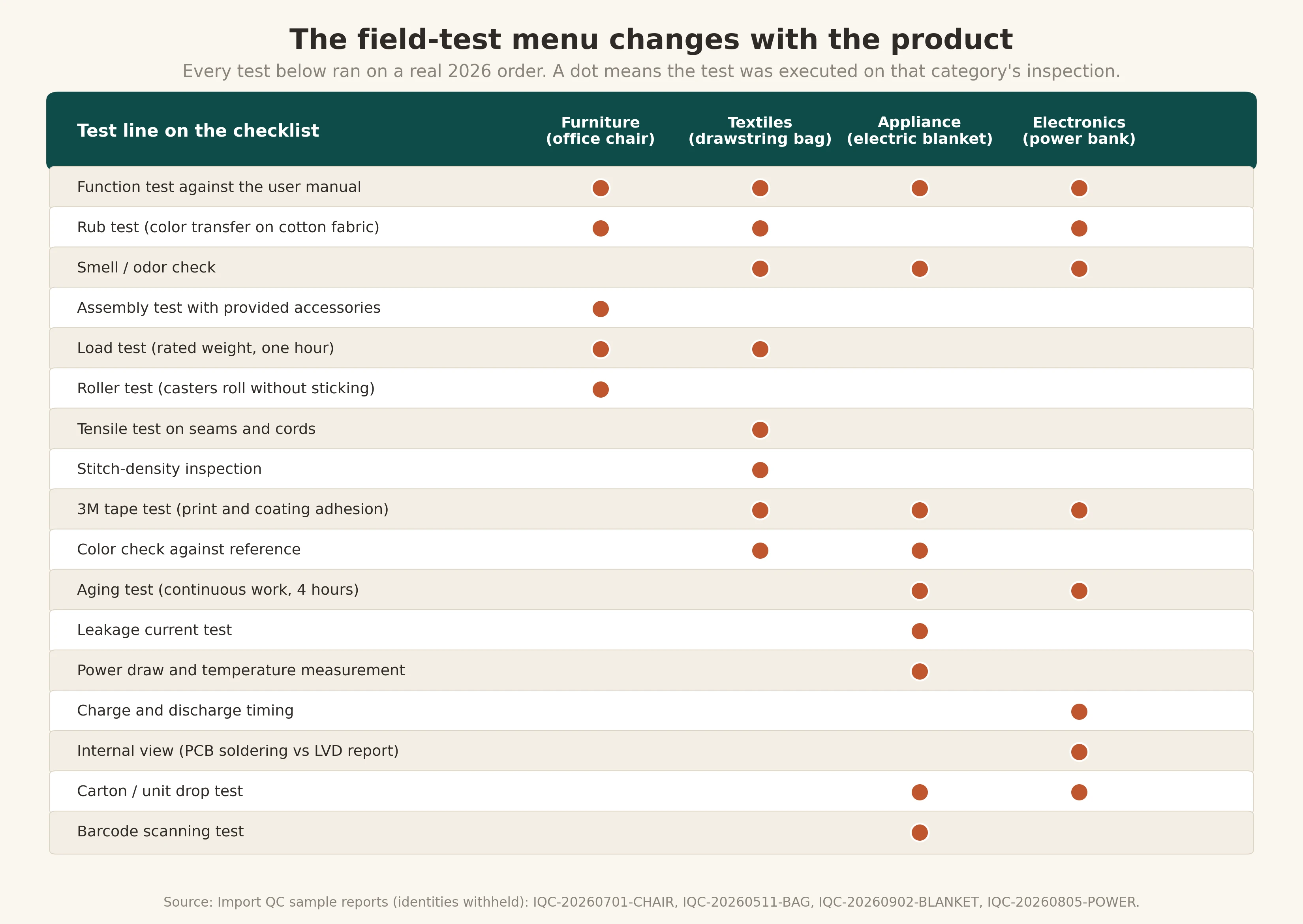
Figure 3. The field-test menu changes with the category. Rows are real tests, columns are real orders from the sample reports library. Source: Import QC reports IQC-20260701-CHAIR, IQC-20260511-BAG, IQC-20260902-BLANKET, IQC-20260805-POWER.
The barcode line deserves a pause. It costs nothing, takes seconds, and prevents a warehouse rejection that strands a container's worth of inventory over a sticker. The carton drop line is its mirror: a free-fall drop sequence on the packed export carton, on corners, edges, and faces, under the same principle as the ISTA 1A and ASTM D5276 protocols. It simulates the worst day of the carton's life, in the factory, where a failure is cheap.
And this section carries the most instructive finding in this article. From the power-bank report (IQC-20260805-POWER, August 5, 2026): the factory did not have the equipment for battery capacity testing, battery voltage testing, output power testing, input power testing, overvoltage protection testing, overcurrent protection testing, or short-circuit protection testing. Seven test lines, not executable on site, because the factory floor lacked the instruments. The checklist does not pretend otherwise. The finding is recorded in the brief report, the tests that could run did run (aging, charge and discharge function, drop, smell, tape adhesion), and the buyer learns two things at once: the state of the goods, and the state of the factory's test bench. A battery factory without a battery tester is a fact worth having before the balance moves.
9. The lines that depend on you
Here is the pattern that only shows up when you read a year's worth of reports side by side. The checklist lines that could not be fully executed almost never fail because of the factory. They fail because of missing buyer inputs:
- Approved sample. Bag report: "No approved sample is available for inspection reference." Blanket report: no confirmed samples provided. Without the golden sample on site, workmanship comparison runs against photographs and memory.
- Color reference. Both reports record that the factory had no Pantone card for color comparison. The color-check line runs, but against no agreed standard.
- Shipping marks and label files. The blanket inspection recorded actual findings against no client reference.
- Measurement data and tolerances. Same report, same gap.
- Component specs. The blanket report still caught a component mismatch: the power cord fitted was model ML-T330, which did not match the product model GL-BL14. That line worked because the mismatch was visible on the units themselves. It would have worked faster with a spec sheet.
So the practical method is a packing list for the inspection, and it is yours, not the inspector's. Before the visit, send:
- The approved sample (physically, to the factory, sealed) or clear counter-sample photos.
- A spec sheet with tolerances, not just target values.
- Pantone or color references.
- Artwork, label files, and barcode specifications.
- Shipping-mark artwork and packing instructions.
- The user manual, if the product has one, because function tests run against it line by line.
- Your defect classification list, if you have one: what you consider critical, major, minor for this product.
- Your AQL settings, if you want anything other than 0 / 2.5 / 4.0.
- Any test that needs equipment beyond the usual kit, named in advance, so the factory's bench can be checked before the visit.
- The PO and PI, so quantities and item numbers reconcile character for character.
Ten lines of email. Every one of them converts a checklist line from "recorded against no reference" into "verified against the reference you chose."
10. When the full checklist is overkill
An honest checklist article needs this section.
- Repeat orders with a clean history. Same factory, same product, three consecutive clean reports: the scope can shrink. Keep the quantity count and the random workmanship sample always; relax the measurement grid and some field tests. What you never relax is randomness and independence.
- Very small, low-value orders. If the balance at risk is a few hundred dollars, the honest math may favor skipping the PSI and absorbing the risk. We say this as the company that sells the inspection.
- When a DUPRO beats a PSI. Long production runs, processes that can drift mid-run, products where a defect found at 100% finished is too late to rework: an inspection during production catches the process while it can still change. The PSI checklist is a verdict on finished goods. It cannot unmake them.
- The factory's own QC. Real factories run real QC, and good ones run it well. What they cannot run is independence. Their QC sheet exists to ship the goods. The third-party checklist exists to decide whether you pay for them. Both documents can be honest; only one works for you.
11. The math of getting it wrong
Start with the market baseline. U.S. retailers expected 15.8% of sales to be returned in 2025, $849.9 billion of merchandise, per the NRF and Happy Returns 2025 Retail Returns Landscape published in October 2025. For online sales, the channel most importers reading this sell into, the expected rate was 19.3%, about one order in five. Not all of that is defects (fit and bracketing drive apparel), but the controllable slice is large: in ICSC's 2024 returns research, damaged items (52%), poor fit (50%), "item not as expected" (42%), and wrong item sent (37%) led the list of reasons shoppers gave for sending things back. Three of those four are checklist lines.
Now the unit economics. A single return costs roughly $10 to $65 to process once shipping, labor, inspection, and restocking are counted, before the lost sale and the review. A PSI samples 80 to 500 units and finds the defects while they still belong to the factory. On our dataset, two-thirds of the defects found were corrected on the spot, at the $1-to-$10 end of the 1-10-100 cost curve, instead of the $100 end your customer finds for you.
And the tail case, because one is in the dataset. A 50,000-unit toy order, sampled at 500 units under the same Z1.4 table (code letter N, accept thresholds in the low twenties). The inspection found 14 major and 24 minor defects, two failed field tests, retail cartons containing the wrong product designs, and only one-fifth of the goods packed at inspection time. FAIL, on arithmetic, not opinion. The buyer had not yet paid the 70% balance. The checklist is the reason that sentence exists.
One honesty note on the arithmetic. A pass does not mean zero defects, and this article's tables prove it: an 80-unit sample passing at AQL 2.5 is statistically consistent with a major-defect rate near 2.5% in the full lot, which on a 5,000-unit shipment still implies around a hundred defective units in the container. What the checklist buys is a measured, documented risk level and a floor that has been watched. That is worth more than a promise, and less than a guarantee, and the report says which.
12. Where the checklist ends
The checklist has edges, and you should know them before you book, not after.
- Laboratory tests. Battery capacity certification, chemical migration, formal hi-pot certification, flammability ratings: these need lab instruments and lab accreditation. Field tests screen; they do not certify. The power-bank finding in section 8 is what the edge looks like in practice.
- Every unit. Sampling is a bet the standard makes explicit: 200 units stand in for 6,000. The bet is sound when the sample is random and the process is stable. It is still a sample.
- The container. The PSI ends at the warehouse door. What gets loaded, swapped, or crushed afterward is a different service (container loading supervision), with its own checklist and its own two minutes that matter: the seal number photo.
- Who you are buying from. A PSI verifies goods. It does not verify the entity. Desk verification and factory audits answer the counterparty question; the checklist assumes you already did.
FAQ
How many units will you check on my order? The table in section 5, read from your lot size. 500 to 1,200 units: 80 checked. 3,201 to 10,000: 200. 35,001 to 150,000: 500. Bigger sample sizes (Level III) are available when the product justifies them.
Can I add my own lines to the checklist? Yes, and you should. The skeleton is fixed; the detail is yours. Defect definitions, special tests, measurement points, packaging rules: all of it can be specified. The only constraint is physics: a test that needs equipment the factory does not have gets flagged, not faked.
Who picks the samples? The inspector, at random, from the full carton stack, on the spot. Never the factory. A pre-selected sample is not a sample; it is a showroom.
Does a passed inspection mean my goods are perfect? No. It means the defect counts in a random sample sat inside limits you agreed to. Section 11 has the arithmetic, including the uncomfortable direction.
What happens to defects found during the day? They go into the disposal table: handled on site, promised, or not handled. On our dataset, about two-thirds get fixed while the inspector is still there. The rest are documented with photos, and the decision (rework, sort, discount, reject) is yours with evidence in hand.
How long does a PSI take, and when do I see the report? One working day on site for a routine order. The photo-documented report follows within 24 hours.
When should the PSI happen? When goods are 100% finished and at least 80% packed, and always before the balance payment moves. The 70% balance is the one lever the factory always answers to; the report tells you whether to release it.
What if the order is not ready when the inspector arrives? It happens, and it is why the booking terms matter. Ours allow free cancellation up to 12 hours before the visit. A factory that is 60% packed on inspection day is telling you something about your ship date; the report records it either way.
Sources
- ANSI/ASQ Z1.4-2008, Sampling Procedures and Tables for Inspection by Attributes (single sampling, General Inspection Level II, Table II-A accept/reject numbers); identical sampling tables published as ISO 2859-1.
- National Retail Federation & Happy Returns, 2025 Retail Returns Landscape, October 2025: $849.9 billion total returns; 15.8% of retail sales; 19.3% of online sales; 16.9% and $890 billion for 2024.
- ICSC (International Council of Shopping Centers), 2024 returns research: leading reasons for online returns, damaged items 52%, poor fit 50%, item not as expected 42%, wrong item sent 37% (multiple selections allowed).
- Industry per-return processing cost estimates ($10 to $65 per returned unit, shipping/labor/inspection/restocking), consistent with returns-industry reporting (Optoro, Radial).
- ISTA Procedure 1A and ASTM D5276: principles behind carton drop testing (drop sequence on corners, edges, faces; drop height by packaged weight).
- The 1-10-100 rule of quality costs (prevention / internal failure / external failure), quality-management literature.
- Import QC sample reports library (identities withheld): IQC-20260511-BAG (drawstring bags, 6,000 units, May 11, 2026); IQC-20260701-CHAIR (office chairs, 676 units, July 1, 2026); IQC-20260805-POWER (power banks, 810 units, August 5, 2026); IQC-20260902-BLANKET (electric blankets, September 2, 2026).
- Import QC defect dataset: twelve pre-shipment inspections, 81,071 units, 141 defective units in samples, roughly two-thirds corrected on site, including the failed 50,000-unit toy order (IQC-20260726-TOY, July 26, 2026). Aggregated in "The anatomy of a failed inspection."
Third-party inspection in China at $149 per man-day, flat. Inspector dispatched within 48 to 72 hours, photo-documented report within 24 hours, free cancellation up to 12 hours before the visit. The sample reports library carries the bag, chair, power-bank, and blanket reports quoted above, free to read, so you can check the checklist against the real documents before you book.
Related reading: The anatomy of a failed inspection · Trading company vs factory: how to tell who you're really buying from · How much does a quality inspection in China cost? (2026)