The short answer: In 2017, a failed $25,000 shipment from China cost you the goods plus roughly $775 in duty. In October 2026, the same failure costs the goods plus $4,375 to $10,000 in duty, depending on your product's tariff stack. At the April 2025 peak it would have been $36,250, more than the goods themselves.
The duty is due at the border whether the goods are sellable or scrap. Defect rates inside Chinese factories did not change in these eight years. What changed is the multiplier sitting underneath every quality failure. A bad shipment used to hurt one quarter's margin. At current rates it can erase the profit of several good ones, and the recovery options after entry are narrow, slow, and mostly unused.
The practical response has not changed and it is still cheap: verify the goods before the balance payment leaves your account. Everything after the border is damage control.
How we got here: the tariff stack, 2018 to October 2026
In January 2018, the average US tariff on Chinese goods was 3.1%, according to the Peterson Institute's running tally. The Section 301 waves of 2018 and 2019 pushed that average to 19.3% by the time the Phase One deal was signed in February 2020, and Phase One kept most of those duties in place.
Then 2025 rewrote the scale. A 10% "fentanyl" tariff landed on February 4, a second 10% on March 4, a 34% "reciprocal" tariff on April 2, and a rapid exchange of escalations took the headline rate on Chinese goods to 145% by April 10 (a 125% reciprocal tariff stacked on the 20% fentanyl tariff, on top of existing Section 301 duties). The Geneva agreement of May 12, 2025 cut that to a 30% stack (10% reciprocal plus 20% fentanyl). A November 1, 2025 agreement halved the fentanyl tariff to 10% and extended the truce to November 10, 2026. The de minimis exemption, which had let low-value parcels skip duty entirely, closed for China in May 2025 and for all countries in August 2025.
On February 20, 2026, the Supreme Court ruled 6-3 in Learning Resources v. Trump that the IEEPA tariffs were unlawful, voiding the fentanyl and reciprocal stacks and exposing the government to what the Tax Foundation estimated at more than $160 billion in potential refunds. The administration replaced them within days with a Section 122 tariff, first 10%, then 15%, which hit that statute's 150-day cap and expired on July 24, 2026. New Section 301 actions followed.
That is where October 2026 sits: the Yale Budget Lab put the statutory average tariff rate at 11.0% in late August 2026, rising toward 11.8% by year-end as newer measures phase in. Averages understate what specific products pay. Issuer filings on the Hong Kong exchange in September 2026 documented product-level stacks on Chinese goods of 40% for ATVs, 35% for e-bikes and e-scooters, and 17.5% for off-road motorcycles. For a typical consumer product imported by a small business, a total stack in the 17.5% to 40% band is the realistic planning range.
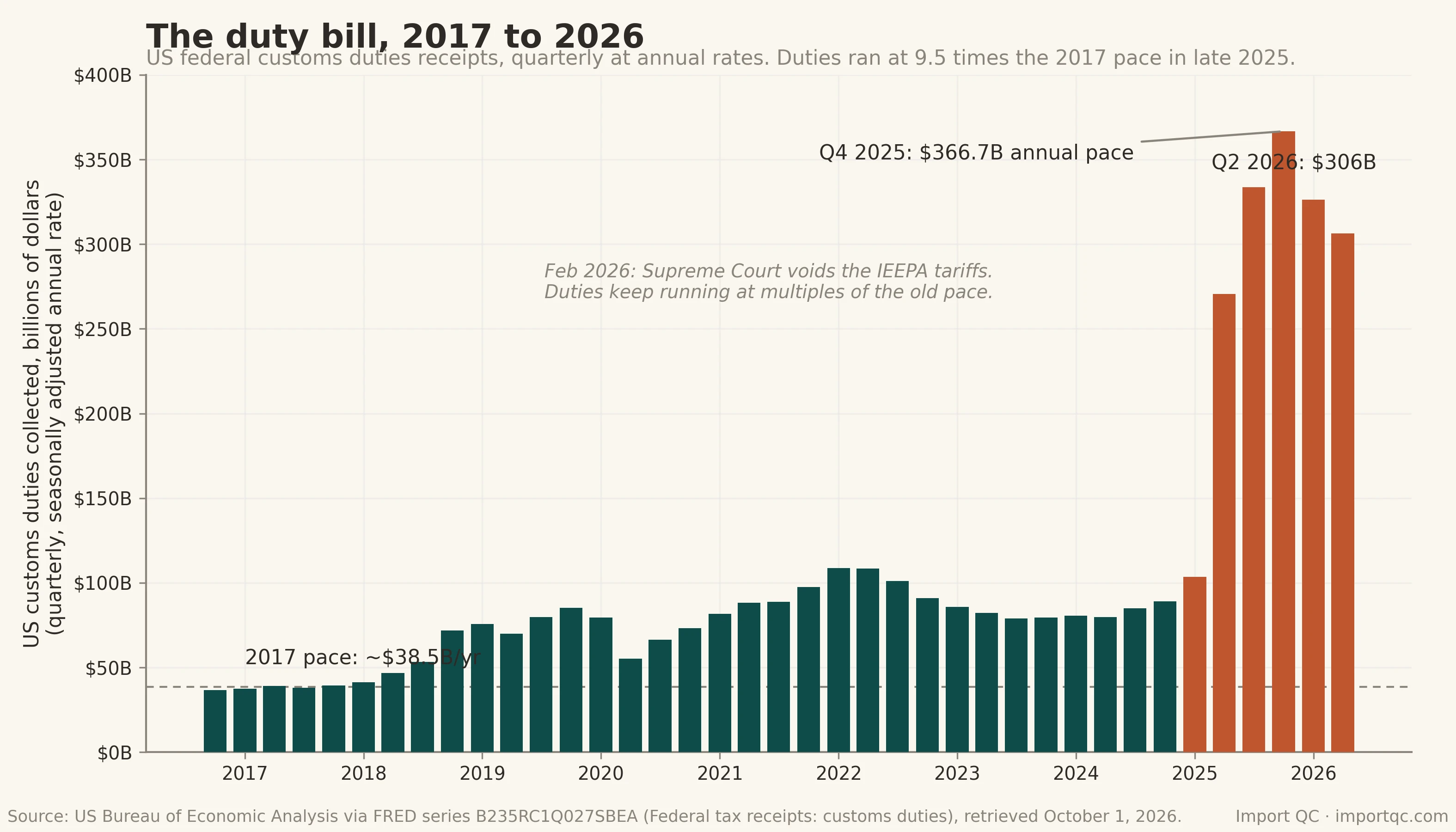
The customs data shows what this meant in cash. Federal customs duties ran at a $38.5 billion annual pace in 2017. They peaked at a $366.7 billion annual pace in Q4 2025, roughly nine and a half times the 2017 rate, and were still running above $306 billion annualized in Q2 2026, after the Supreme Court ruling. Customs and Border Protection reported collecting more than $200 billion in tariffs during calendar 2025. Whatever the legal status of any single tariff program, importers are wiring duty payments at a scale that has no precedent in modern US trade history, and a share of that money is attached to goods that will never be sold.
The same shipment, a different bill
Take a $25,000 FOB shipment of China-origin goods, the size of a routine first order for a small brand. Duty is assessed on the customs value at entry. It does not depend on whether the goods work, match the specification, or can be sold.
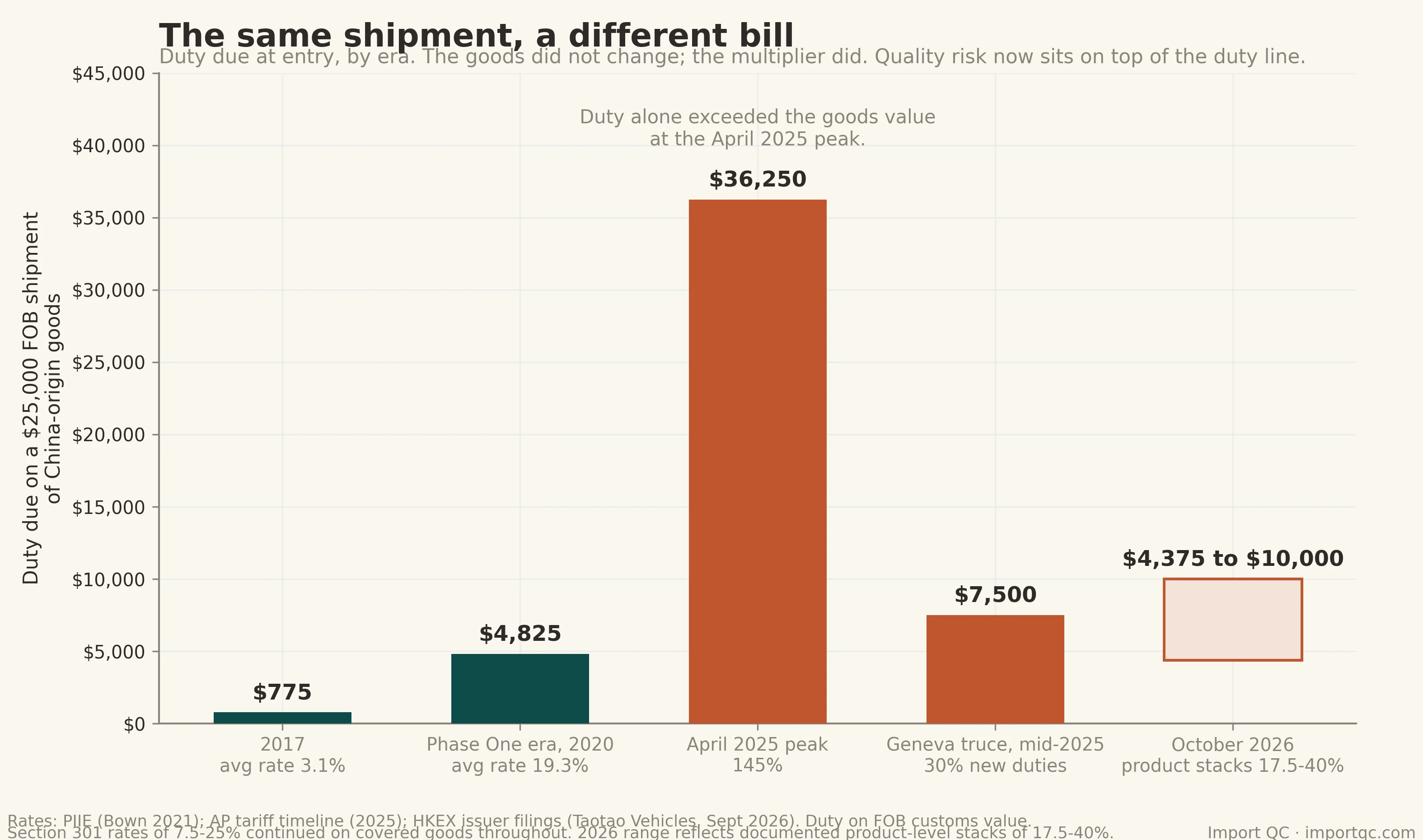
| Era | Approximate rate | Duty due at entry |
|---|---|---|
| 2017 average | 3.1% | $775 |
| Phase One era, 2020 | 19.3% | $4,825 |
| April 2025 peak | 145% | $36,250 |
| Geneva truce, mid-2025 | 30% stack | $7,500 |
| October 2026 | 17.5% to 40% stacks | $4,375 to $10,000 |
At the April 2025 peak, the duty alone exceeded the value of the goods. That extreme lasted weeks, not months, but it demonstrated something that remains true at today's lower rates: the tariff system now multiplies the cost of every other problem. A defect wave in 2017 rode on a $775 duty line. The same defect wave in 2026 rides on a duty line six to thirteen times larger.
One mechanics note, because it surprises first-time importers: the duty is collected at entry, through your customs broker, against the bond on file, within days of the container clearing. There is no invoice period and no quality condition attached. CBP does not know or care whether the goods in the container work.
What a failed shipment costs in 2026
Duty is only one line in the failure. Here is the full cash stack for that $25,000 shipment, at a mid-range 30% duty stack, with typical freight and end-of-life costs:
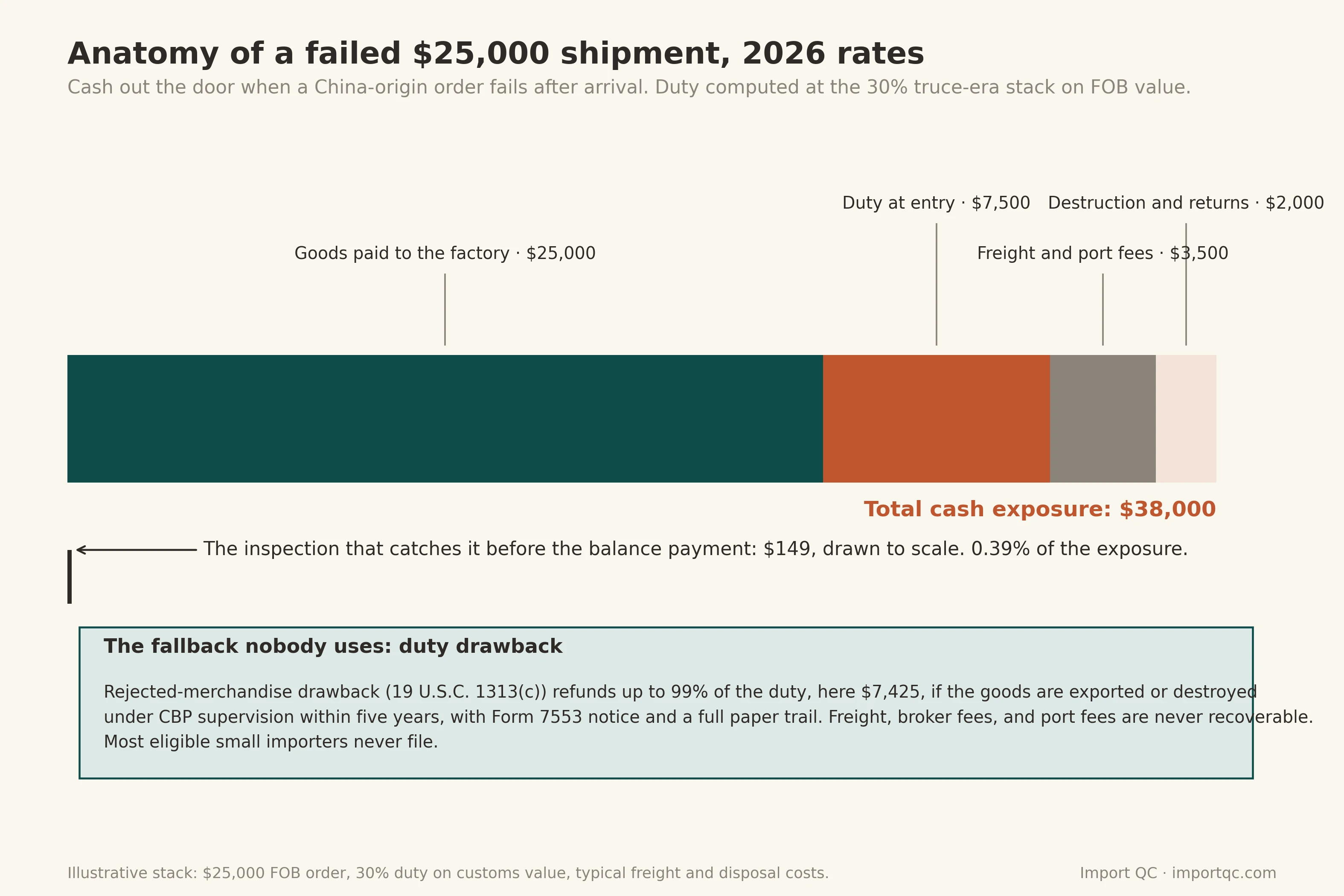
The goods cost $25,000. The duty at entry costs $7,500. Freight, insurance, and port fees add roughly $3,500. If the goods arrive unsellable, destruction or return shipping adds roughly $2,000 more. Total cash exposure: about $38,000, before counting the lost sales season, the marketplace ranking damage, or the replacement order that also pays duty.
One part of that stack is partially recoverable, and most small importers never recover it. Under the rejected-merchandise drawback provision (19 U.S.C. 1313(c)), an importer can claim back up to 99% of the duty paid on goods that are exported or destroyed under CBP supervision within five years of entry. In the worked example, that is up to $7,425 back on the $7,500 duty line. The catch is procedural: you must notify CBP on Form 7553 before the export or destruction (five working days ahead for export, seven for destruction under 19 CFR 190.35), keep the entry summary and proof of the goods' condition, and run the process within the statutory window. Section 301 duties are drawback-eligible. Drawback service firms have long reported that most qualifying importers never file a claim, and the freight, broker, and port fees are never recoverable under any program.
So the realistic outcome of a failed 2026 shipment is this: if you are organized, you recover most of the duty and eat the rest, a loss of roughly $30,500 on a $25,000 order. If you are not organized, you eat all $38,000. And the replacement order you then place pays the same duty again on arrival, six to eight weeks later, likely into a missed sales season.
What defects look like in real inspection reports
Tariff risk is only half the equation. The other half is how often goods go wrong. Our own sample reports offer a window. Across 13 anonymized inspection reports from 2026, covering 90,555 units of consumer and industrial goods, inspectors checked 1,376 units and found 117 defect units: zero critical, 27 major, and 90 minor. That is a 2.0% major-defect rate and an 8.5% any-defect rate in the samples. This is a convenience sample of our own 2026 casework, not an industry-wide estimate, but the spread inside it is instructive.
| Product, 2026 | Lot size | Checked | Critical | Major | Minor |
|---|---|---|---|---|---|
| Forklifts (full inspection) | 23 units | 23 | 0 | 12 | 5 |
| Sports shoes | 8,244 pairs | 200 | 0 | 7 | 12 |
| Foot spa (MFS-550) | 1,000 pcs | 80 | 0 | 3 | 12 |
| Sealing machine parts | 66,212 pcs | 203 | 0 | 2 | 6 |
| Slippers (re-inspection) | 6,048 pairs | 200 | 0 | 1 | 11 |
| Foot massager | 700 pcs | 80 | 0 | 1 | 4 |
| GFA-8500 | 2,040 pcs | 125 | 0 | 1 | 6 |
| Electric blanket | 1,012 pcs | 80 | 0 | 0 | 5 |
| Massage gun | 500 pcs | 50 | 0 | 0 | 5 |
| Power bank | 700 pcs | 80 | 0 | 0 | 11 |
| Suitcase | 3,000 pcs | 125 | 0 | 0 | 6 |
| Office chair | 676 pcs | 80 | 0 | 0 | 4 |
| Multi-item order (PI Dubai/Futuro) | 400 pcs | 50 | 0 | 0 | 3 |
| Total | 90,555 | 1,376 | 0 | 27 | 90 |
Averages hide the interesting cases:
- The full inspection of 23 forklifts in July 2026 found 12 units with major defects and 5 more with minor ones, a 52.2% major rate, including controller faults that left units unable to drive forward. The shipment was defective as made, and only a 100% check could show it.
- The 8,244-pair sports shoe inspection sampled 200 pairs and found 7 major and 12 minor defects. That is a 3.5% major rate, and the shipment still passed at AQL 2.5, because the acceptance limit was 10 majors in the sample. A passed report at that base rate implies roughly 289 pairs with major defects in the shipped lot.
- The 66,212-piece sealing machine order found 2 majors in a sample of 203, a 0.99% rate. Applied to the full lot, that projects to roughly 650 defective units riding on one PO.
- The slippers re-inspection recorded holes in the upper material. The factory's written explanation was that the holes were "caused by the production process and is unavoidable." That sentence is what a re-inspection is for.
- Smaller failures carry their own costs. A suitcase order specified a 35mm label and got 30mm. A foot spa's cartons were printed with a gross weight of 2.7kg against an actual 3.07kg, an 11% error that flows straight into freight billing and customs paperwork. A power bank order arrived with stickers covering the gift box's printed content. A massage gun order's inner cartons did not match the specified size.
None of these findings are sabotage. They are ordinary production variance, caught because someone counted. And here is the detail that ties this section to the rest of the article: every one of those 13 reports ends with the same overall conclusion, "Pending." A report never carries its own verdict; the decision belongs to the buyer, ideally made before the balance payment, because after the goods ship, the tariff meter starts running on whatever is in the container, good or defective.
You can read the underlying documents yourself on our sample reports page.
Why the math turned existential for small importers
Large importers treat a failed shipment as a line item. A small importer often has one active PO at a time, and that PO is most of the company's working capital. The change since 2017 runs in both directions at once: failures cost more, and the profit per good shipment shrank, because the duty line eats margin on every shipment, not just the bad ones.
A worked example, with assumptions stated so you can adjust them to your own numbers. Suppose you buy at $25,000 FOB and sell at roughly 2.2 times FOB, $55,000 in revenue, and suppose net margin after all costs lands near 10% of revenue, about $5,500 per successful shipment.
- In 2017, landed cost was about $29,275 (goods, $775 duty, $3,500 freight). A total failure cost about $31,000 with disposal. Recovery required the net profit of roughly five to six good shipments.
- In 2026, landed cost at a 30% stack is about $36,000 before any defect exists. A total failure costs about $38,000, or $30,500 if you file drawback correctly. If you raised your retail price in line with the market (imported core goods prices ran about 13% above trend in early 2026, per the Yale Budget Lab), your net per good shipment is roughly unchanged, and one failure wipes out the profit of six to seven of them. If you absorbed the duty instead of passing it on, your per-shipment margin shrank while the failure loss grew, and the ratio gets worse from there.
The damage does not stop at the cash loss. A failed shipment that reaches customers becomes a review problem: Harvard Business School research on online reviews found each additional star in a business's average rating is associated with 5% to 9% more revenue, and the reverse runs on the way down. Marketplace rankings compound it.
Passing the duty to customers has limits. Studies reviewed by the Yale Budget Lab put pass-through to consumer prices in the 46% to 86% range depending on category. That means the market has already absorbed most of the price increase it will absorb. The rest comes out of the importer's margin, which is the same buffer that used to absorb a bad shipment.
There is also a timing problem. The 70% balance left your account before the goods shipped. The duty is due within days of entry. The drawback refund, if you file one, takes months. For six to twelve weeks after a failure, the money is gone in three directions at once, and the replacement order needs a new deposit. For a business running on a credit line, that gap is where the word "business-threatening" stops being dramatic and starts being literal.
What changes the outcome
The countermeasures are not new, and none of them cost much relative to the exposure. What changed is the return on doing them.
- Inspect before the balance, not after the arrival. A pre-shipment inspection runs when production is finished, conventionally when 100% of goods are produced and at least 80% are packed. At that point the factory still needs your 70% balance, which is the one moment in the transaction when your bargaining power and your need for information align. If you are negotiating payment terms, tie the balance explicitly to the PSI result.
- Read AQL correctly. A pass at AQL 2.5 does not mean zero defects, as the 8,244-pair shoe order shows: it means the sample stayed under an acceptance limit while a measurable defect rate ships. For high-value, low-volume orders like the forklifts above, a full inspection is the only version that answers the question you are asking.
- Treat the supplier's answer as data. A factory that tells you holes are "unavoidable" has told you what the next order will look like. Budget for the re-inspection.
- Check the boring fields. Carton gross weights, label dimensions, and carton markings feed freight billing and customs declarations. An 11% weight error is a cost line, not a typo.
- Keep a drawback-ready file from day one. Entry summary, commercial invoice, proof of payment, photos of the defect, and the inspection report that documents the goods' condition. If the shipment fails, Form 7553 goes to CBP before anything is destroyed or exported, inside the five-year window. This is the difference between eating $38,000 and eating $30,500.
- Know your HTS code and your actual stack. "Tariffs are 30%" is a headline, not a planning number. Documented 2026 stacks run from 17.5% to 40% depending on the product. Your broker can confirm your line in an afternoon; the answer determines how much failure you can afford.
Honest limits
This analysis has edges, and you should know them before acting on it.
- Rates vary by product. The 30% stack used in the worked example is a mid-range planning figure, not your rate. Some HTS lines pay less, some pay more, and 2026 policy has moved quarterly.
- Policy cuts both ways. The Supreme Court voided the IEEPA tariffs in February 2026, and the Tax Foundation estimated potential refund exposure above $160 billion. Some duties paid in 2025 and early 2026 may yet be refunded. Do not plan on it, but do keep the entry records that would let you claim.
- Sampling is probabilistic. An AQL inspection estimates a lot's quality from a sample; it does not certify every unit. The forklift case shows the alternative when the unit economics justify it.
- Drawback is paperwork-bound. The 99% refund is real, but it requires supervision, notice, and records, and it never covers freight or fees. Talk to a customs broker or drawback specialist before you need one.
- Inspection finds what is visible and testable at the factory. It does not fix a bad design, enforce a contract by itself, or guarantee a supplier's next order. It tells you what you are about to pay for, while you still hold the money.
FAQ
What tariff rate applies to my product right now? It depends on your HTS classification and which programs currently cover it. As of October 2026, documented product-level stacks on Chinese goods range from 17.5% to 40%, against a statutory average near 11%. Your customs broker can pin your line to the current Federal Register notices.
Is duty charged on what I paid the factory, or on my landed cost? On the customs value, which for a typical FOB transaction is close to the goods' price, excluding international freight and insurance. The duty is due at entry regardless of the goods' condition.
If the shipment fails after arrival, can I get the duty back? Usually, mostly, if you follow the drawback rules: up to 99% under 19 U.S.C. 1313(c), provided the goods are exported or destroyed under CBP supervision within five years and you filed Form 7553 notice first. Freight and broker fees are never refunded.
Does a passed inspection mean zero defects? No. AQL is an acceptance-sampling standard. A lot can pass at AQL 2.5 while carrying a low single-digit percentage of major defects, as our 8,244-pair shoe report shows. A pass means the defect rate is inside the agreed tolerance, which is why the tolerance and the sampling plan matter.
How often do inspections find serious problems? In our 13 sample reports from 2026, covering 90,555 units, inspectors found major defects in samples at a 2.0% rate on average, with outliers as high as 52% on a full inspection of high-value machinery. Most findings are ordinary production variance, not fraud.
What did the 2025 to 2026 tariffs cost US importers overall? CBP reported collecting more than $200 billion in tariffs in calendar 2025. Federal customs duties peaked at a $366.7 billion annual pace in Q4 2025, about nine and a half times the 2017 pace, per the BEA series we chart above.
Will rates come down? They already have, twice (Geneva in May 2025, the Supreme Court ruling in February 2026), and they have gone back up in other forms both times. Planning around a specific future rate has failed for eight years running. Planning around a band, and around what you can verify before paying, has held up.
What does an inspection cost relative to the exposure? $149 per man-day covers a standard pre-shipment inspection for most consumer goods. Against the $38,000 exposure in the worked example, that is 0.39%.
Related reading: Trading company vs factory: who you're really buying from
Sources
- Chad Bown, Peterson Institute for International Economics, US-China trade war tariff averages (3.1% January 2018 to 19.3% February 2020).
- Associated Press, tariff timeline coverage, February to May 2025 (fentanyl tariffs, reciprocal escalation to 145%, Geneva agreement May 12, 2025).
- Hong Kong Exchange issuer filings, September 2026 (Taotao Vehicles and peers): November 1, 2025 terms, product-level duty stacks of 17.5% to 40%.
- Supreme Court of the United States, Learning Resources v. Trump, decided February 20, 2026 (6-3), voiding tariffs imposed under IEEPA.
- Tax Foundation, estimate of potential IEEPA tariff refunds exceeding $160 billion, 2026.
- Yale Budget Lab, analyses of April 2, 2026 and August 24, 2026: statutory average rate 11.0% rising toward 11.8%; effective rate near 10.6% in January 2026; imported core goods prices roughly 13% above trend; pass-through estimates.
- US Customs and Border Protection collections reporting via CNBC, December 2025 (over $200 billion in calendar 2025) and February 2026.
- US Bureau of Economic Analysis, federal customs duties series (FRED B235RC1Q027SBEA), retrieved October 1, 2026.
- 19 U.S.C. 1313(c) and 19 CFR Part 190 (drawback); CBP Form 7553 notice requirements.
- Michael Luca, Harvard Business School working paper, "Reviews, Reputation, and Revenue: The Case of Yelp.com" (each additional star associated with 5% to 9% revenue change).
- Import QC anonymized sample inspection reports, 2026 (13 reports, 90,555 units), available at /sample-reports/.
One paragraph on pricing
A pre-shipment inspection from Import QC costs $149 per man-day, with an inspector on site in 48 to 72 hours anywhere in China and a photo-documented report in your inbox within 24 hours of the visit. In the worked example above, that fee is 0.39% of the cash exposure of a failed shipment at 2026 duty rates, and it is the only line in the whole stack that produces information while the 70% balance is still yours to hold. Book one when production finishes, and decide with the report open.