The short answer: Under EXW, risk passes to the buyer at the factory gate, before the goods are even loaded, so every defect inside the cartons is the buyer's property from the moment the truck arrives. Under FOB, the seller carries risk until the goods are on board the vessel at the named Chinese port. Under CIF, risk passes at the same point as FOB; the insurance the seller buys is for the buyer's benefit, but at the minimum level the rule allows, which excludes theft, ordinary water damage, and any defect the goods already had. What none of the three terms governs is quality. Conformity risk is allocated by the sales contract and, for an American buyer purchasing from a Chinese supplier, by the UN Convention on Contracts for the International Sale of Goods (CISG), which holds the seller liable for defects that existed at the moment risk passed. The practical conclusion is one sentence: the inspection belongs before the risk-transfer line, under all three terms, and the report is the evidence that pins a defect to the seller's side of that line.
This article maps the three terms properly: where each one moves risk, where each one leaves inspection risk, and what the legal layer underneath (the CISG) does with the evidence an inspection creates.
1. The situation: three quotes, three different deals
You send the same purchase order to three factories, or one factory prices your order three ways. EXW Shenzhen: $8.40 a unit. FOB Shenzhen: $8.95. CIF Long Beach: $9.60. The spreadsheet says EXW is cheapest, CIF is the one where "the supplier handles shipping and insurance," and FOB sits in between. Most first-order decisions get made on that spreadsheet.
The spreadsheet compares prices. The three letters compare risks, and they are not the risk buyers assume. Each of these terms answers a narrow question: at which geographic point does the risk of loss or damage to the goods move from seller to buyer, and who pays which leg of the route. They say nothing about whether the goods are right. A container of correctly shipped, perfectly insured, defective product is a fully compliant delivery under all three terms.
So "which Incoterm puts inspection risk on whom" splits into two questions. First, where does each term draw the risk line, because that line decides which defects, damages, and disputes land on you. Second, what law allocates the quality risk the Incoterm ignores, because that is where an inspection report becomes more than a quality document. It becomes legal evidence with a timestamp.
2. What the three terms decide, and what they leave open
Incoterms® are the International Chamber of Commerce's standard trade terms. The current edition is Incoterms 2020 (ICC Publication No. 723E), in force since January 1, 2020, eleven rules in total, of which four (FAS, FOB, CFR, CIF) apply to sea and inland waterway only. They allocate costs, tasks, and the risk of loss or damage in transit. They do not govern title to the goods, payment terms, or remedies for breach. Those belong to the contract and the law behind it.
EXW (Ex Works, named place). The seller's job ends when the goods sit ready at the named place, usually the factory or its warehouse. The seller does not have to load the truck, and does not have to clear the goods for export. Risk passes to the buyer the moment the goods are placed at the buyer's disposal, before loading. Every later event (loading damage at the factory, the truck to the port, the terminal yard, the voyage, import clearance, duties, delivery) belongs to the buyer.
FOB (Free On Board, named port of shipment). Sea freight only. The seller delivers the goods, cleared for export, on board the vessel the buyer nominated at the named port. Risk passes when the goods are on board. Before that moment, loading damage, trucking damage, and terminal handling are the seller's problem. After it, the voyage is the buyer's. The buyer books and pays the ocean freight and decides about insurance.
CIF (Cost, Insurance and Freight, named port of destination). The most misread of the three. The seller pays the freight to the destination port and must buy marine cargo insurance for the buyer's benefit, but risk still passes on board at the port of shipment, the same point as FOB. The seller is paying for a voyage whose risk already belongs to the buyer. If the container is damaged mid-ocean, the loss is the buyer's; the buyer's remedy is a claim on the policy the seller procured. And the policy floor is low: Incoterms 2020 requires cover at Institute Cargo Clauses (C), for at least 110% of the contract value. Clauses (C) is a named-perils cover: fire, explosion, stranding, sinking, collision, jettison, general average. It excludes theft and pilferage, ordinary water damage, loss caused by delay (clause 4.5), and loss caused by inherent vice or the nature of the goods (clause 4.4), which is the clause insurers point to when the "damage" turns out to be a manufacturing defect. The 2020 edition raised the parallel obligation under CIP to broad Clauses (A) all-risks cover, but deliberately left CIF at (C), because CIF serves the bulk commodity trades where cargo is resold in transit.
One historical trap survives in old contracts. Before Incoterms 2010, the FOB risk point was the ship's rail; the 2010 edition moved it to "on board." A contract that says "FOB Shanghai" without an edition invites an argument about which rule applies. Write "Incoterms 2020" and the exact port.
A second trap is structural. FOB assumes the seller controls the goods until they are on board. Containerized cargo does not work that way: the box is handed to the carrier at a terminal days before loading, and under strict FOB the seller carries the risk for goods sitting in a yard it does not control. The ICC's own introduction to Incoterms 2020 advises sellers of containerized goods to sell FCA, where risk passes at the terminal handover, and the 2020 edition added an FCA option (A6/B6) letting the buyer's carrier issue an on-board bill of lading so letters of credit still work. Most consumer-goods imports from China move in containers sold on FOB paperwork. The gap is real, it is documented, and it is where "who pays for the crushed cartons" arguments live.
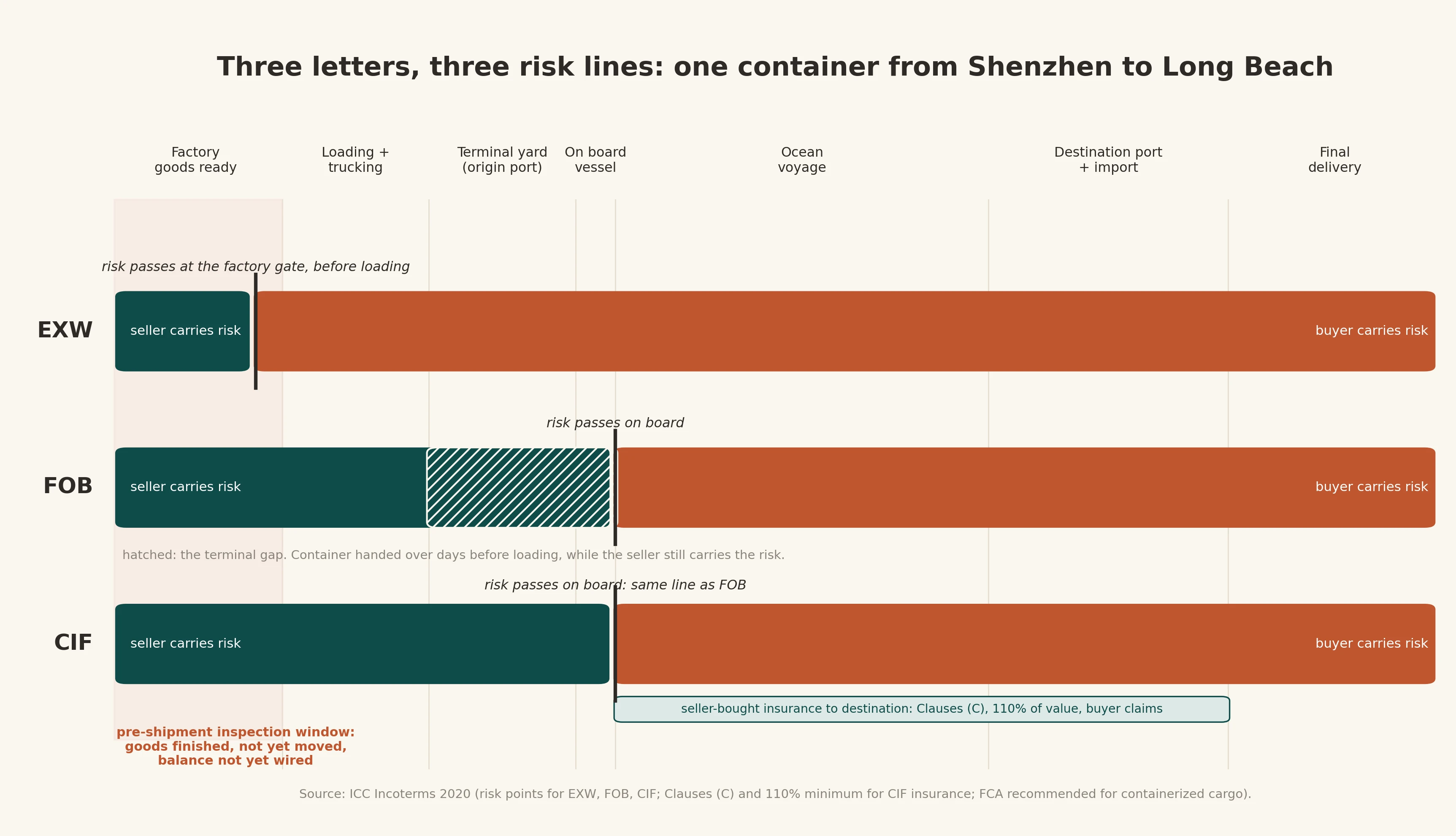
Figure 1. One shipment, three risk lines. Under EXW the buyer owns every event from the factory gate, including loading. Under FOB and CIF the line sits at on board, but containerized cargo leaves the seller's hands at the terminal days earlier, the gap the ICC addresses by recommending FCA. CIF adds a seller-bought policy (Clauses (C), 110% of value) without moving the line. Risk points per ICC Incoterms 2020.
3. The layer that governs quality: the CISG
Incoterms draw the risk line. A different instrument decides who answers for goods that were already wrong when they crossed it.
The CISG is a UN treaty, in force since 1988, with 97 contracting states as of 2026 (UNCITRAL status table). Both the United States and China are parties; both entered in 1988, and in the US the Convention is federal law that preempts conflicting state sales law. When a business in one contracting state sells goods to a business in another, the CISG applies by default unless the contract excludes it (Article 6). A clause saying "governed by the laws of New York" does not exclude it; US courts have repeatedly held that only an express exclusion does. Both countries made the Article 95 reservation limiting the Convention's indirect application, which does not matter for a direct US-China sale; China withdrew its written-form reservation (Article 96) in 2013.
Four articles carry this article's argument:
Article 35. The seller must deliver goods that conform in quantity, quality, and description, and that are fit for their ordinary or particular purpose.
Article 36. The seller is liable for any lack of conformity that exists at the moment risk passes to the buyer, even if it becomes apparent only later. This is the hinge. Risk passing does not launder a pre-existing defect; the rule of breach overrides the passing of risk. Under FOB and CIF, a defect present when the container was loaded is the seller's breach, no matter when it is discovered. Under EXW, the relevant moment is the factory gate.
Articles 38 and 39. The buyer's side of the bargain. Article 38 obliges the buyer to examine the goods, or have them examined, within as short a period as is practicable; where the contract involves carriage, examination may wait until the goods arrive at destination. Article 39 says the buyer loses the right to rely on a non-conformity unless the seller gets notice specifying its nature within a reasonable time after the buyer discovered it or ought to have discovered it, with a hard outer limit of two years from handover. Case law on "reasonable time" runs, depending on the goods and the court, from about one or two weeks to around a month (UNCITRAL Digest of Case Law on the CISG; CISG Advisory Council Opinion No. 2, 2004; Mazzotta, Journal of Law & Commerce, 2019). Miss the notice window and the claim is gone, no matter how real the defect.
Article 40 (and 44). The escape valves. A seller that knew or could not have been unaware of the non-conformity cannot hide behind Articles 38 and 39. A buyer with a reasonable excuse for late notice keeps a price reduction and damages other than lost profit.
Now the part that matters operationally. Every dispute over a bad shipment eventually reduces to one evidentiary question: did the non-conformity exist when risk passed, or did it happen after? "Scratched enclosures" can be a factory defect (seller, Article 36) or terminal handling (buyer, under FOB once loaded). "Water in the foot spas" can be a failed seal test (seller) or container condensation at sea (buyer, uninsured under Clauses (C)). Both sides will argue their version. The party with dated, photographed, third-party evidence from before the risk line wins that argument, and the party without it is negotiating from memory.
That is what "inspection risk" means in this article: the risk of reaching a quality dispute with no evidence from before the line. The Incoterm decides where the line is. The CISG decides what the line does. The inspection decides which side of the line the facts are on.
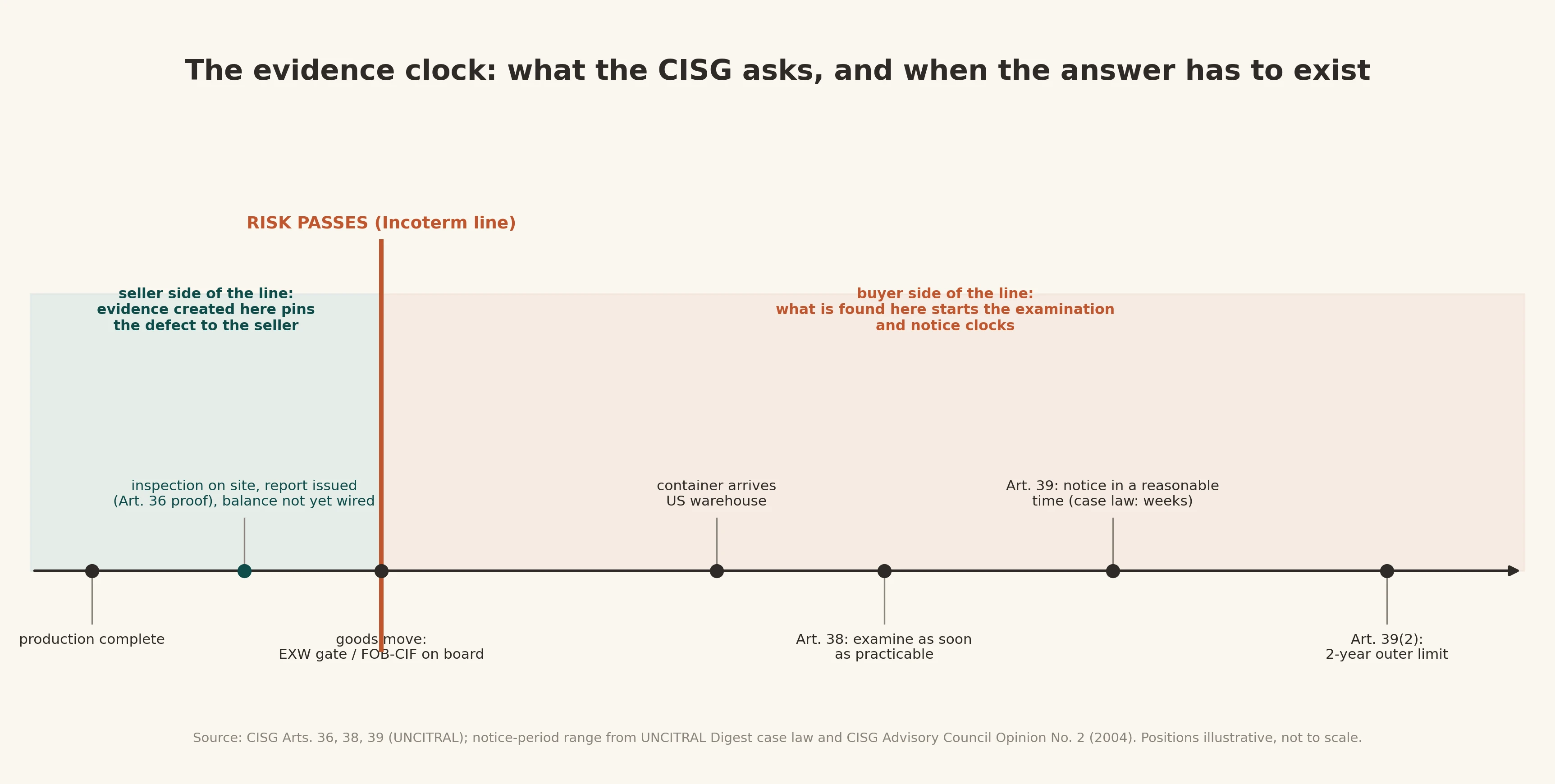
Figure 2. The evidence clock. A pre-shipment report is created before risk passes, which makes it Article 36 proof that a defect existed on the seller's side of the line. After arrival, Article 38 demands examination as soon as practicable and Article 39 sets the notice clock: roughly one to four weeks in the reported case law, two years at the outside. Evidence created before the line answers the question the dispute will ask.
4. The un-copyable proof: what the evidence looks like
From our own defect dataset (twelve pre-shipment inspections, 81,071 units, 141 defective units in the samples, aggregated in "The anatomy of a failed inspection"): two-thirds of the defective units found were reworked or replaced during the inspection itself. In CISG terms, two-thirds of a future Article 36 claim was cured before risk passed, and the balance payment went out against conforming goods.
Two rows from that dataset show the evidence function directly.
The electric-blanket inspection (September 2026, 80 units sampled from the lot) recorded that the fitted power cord, model ML-T330, did not match the product model GL-BL14. A spec mismatch is a conformity defect under Article 35, not a transit event. Because the report exists, dated before shipment, with photos, the question "was this wrong when risk passed?" is already answered. Had that batch shipped FOB and the mismatch surfaced in a US warehouse six weeks later, the buyer without that report would be arguing from photographs taken after arrival, after ocean transit, inside the Article 38 examination window, hoping the seller concedes the timeline. With the report, the mismatch is pinned to the seller's side of the line on the day it was found.
The drawstring-bag inspection (May 2026, 6,000 pieces, 200 sampled) found two major defects and six minor, and the report records, verbatim: "All defective products were not reworked or replaced on site." The buyer decided with that sentence in hand, before the balance moved, while the goods still sat in the factory. Under any of the three Incoterms, that is the last moment the buyer holds all the cards: goods not yet at risk-transfer, money not yet transferred, findings documented. After the line, under EXW the earliest of the three, both levers are gone.
The timing mechanics favor the buyer who plans. A pre-shipment inspection is booked when production finishes, the inspector is on site within 48 to 72 hours, and the photo-documented report arrives within 24 hours of the visit. The report exists before the goods move, before the balance is wired, and comfortably inside any Article 38 period, because Article 38 asks for examination "within as short a period as is practicable" and a documented examination at origin, before carriage, is as short as it gets.
5. Term by term: where each one leaves the inspection risk
EXW: the whole map is yours, including the part the factory drew. Risk passes at the factory gate, before loading. Loading damage is yours even if the seller's own forklift crew causes it, because strictly the seller is only "assisting." The inspection must therefore happen before your truck arrives, and the findings must be settled before you let the goods move at all; once they do, every defect in the cartons is your property. Then comes the China-specific trap the ICC has flagged since 2010: under EXW, export clearance is the buyer's obligation, and Chinese customs requires a locally registered exporter of record. A foreign buyer cannot file it. In practice your forwarder borrows or hires a Chinese exporter of record, which adds cost and means a third party's name sits on your export declaration. The ICC's own guidance says EXW was written mainly for domestic trade and recommends FCA for cross-border sales for this reason. EXW also interacts badly with evidence: no seller obligation to provide anything beyond making the goods available, so your inspection clause has to do all the work (access, timing, samples, rework terms).
FOB: the seller owns the origin leg, and that is worth more than it looks. The seller carries risk through loading at its premises, the truck to the port, export clearance, and terminal handling until on board. A defect or damage created in any of those stages is the seller's problem under both the Incoterm and the CISG. Your inspection window is the same as EXW's in practice (at the factory, before shipment), but the legal posture is friendlier: if the inspector finds defects, the goods have not moved, the seller still bears the risk, and the rework happens on the seller's side of the line. Two cautions. First, the container gap from section 2: the box leaves the seller's control at the terminal, but under strict FOB the seller still carries the risk, which is an argument nobody wants to fund; FCA with the on-board bill of lading option (A6/B6) is the ICC's recommended fix. Second, FOB's protection ends at the rail of the vessel; nothing about FOB checks whether the goods inside were right.
CIF: same risk line as FOB, plus a thin policy with your name on it. The seller arranges and pays freight and insurance to your port, and risk still passes on board at origin. The buyer-side comforts are real (one invoice, no freight booking, a policy exists) and the buyer-side illusions are specific: the insurance covers casualties, not defects (inherent vice, clause 4.4); the default level is Clauses (C) unless the contract upgrades it to (A); the insured value floor is 110% of the contract price; and the claim is yours to file, against a policy you did not negotiate, for a loss the seller does not bear. For quality purposes CIF behaves like FOB: the conformity question is settled, or not, before loading, and nothing after that point creates new seller obligations.
The compressed version:
| EXW | FOB | CIF | |
|---|---|---|---|
| Risk passes to buyer | At seller's premises, goods ready, before loading | On board vessel, named port of shipment | On board vessel, port of shipment |
| Loading at factory | Buyer's cost and risk (seller "assists") | Seller | Seller |
| Export clearance in China | Buyer (needs a local exporter of record) | Seller | Seller |
| Ocean freight | Buyer | Buyer | Seller |
| Insurance | Buyer's choice, no obligation | Buyer's choice, no obligation | Seller must buy: Clauses (C), 110% of value, buyer is beneficiary |
| Pre-shipment inspection window | Before pickup; last chance before everything is yours | Before loading; seller still bears risk | Before loading; same as FOB |
| Conformity defects (CISG Art. 36) | Seller liable for what existed at gate handover | Seller liable for what existed at loading | Same as FOB |
| Transit casualties | Buyer | Buyer | Buyer (claims on seller's policy) |
6. The method: six contract-side moves
Incoterms are default allocations. Contracts override them, and six moves close most of the inspection-risk gap regardless of which term you sign.
- Name the edition and the exact place. "FOB Shanghai, Incoterms 2020," not "FOB China." The named place is where the risk line sits; vagueness hands it to a judge.
- Write the inspection into the payment clause. One sentence does it: balance payable against a passed third-party pre-shipment inspection report, with rework and re-inspection at the seller's cost on a failed result. This converts the inspection from a service you buy into a contract gate the seller must pass, and it works under every Incoterm because it lives in the contract, not the term.
- Containers: prefer FCA, or fix the FOB gap. If the cargo moves in boxes, FCA transfers risk at the terminal handover, matching reality, and the A6/B6 option preserves the on-board bill of lading a letter of credit needs (UCP 600, Article 20). If you stay on FOB, accept that the terminal-yard period is disputed ground and keep evidence from the factory.
- On CIF, upgrade the policy in writing. Specify Institute Cargo Clauses (A) and 110% of contract value, and ask for the certificate before the vessel sails. The premium difference is small; the cover difference is theft, pilferage, and water damage.
- On EXW, either switch to FCA or rebuild the missing obligations. Loading responsibility, export-clearance handling by the seller as the registered exporter, and the inspection right all need to be written in, because the term supplies none of them.
- Run an evidence protocol around the risk line. Inspection dated before risk transfer; photos of product, cartons, marks, and container loading; report archived with the PO and the bill of lading. If a dispute comes, this file is the Article 36 answer and the Article 38 proof at the same time. Under EXW the protocol matters most, because the line is earliest. Under FOB and CIF it covers the terminal gap and the conformity question.
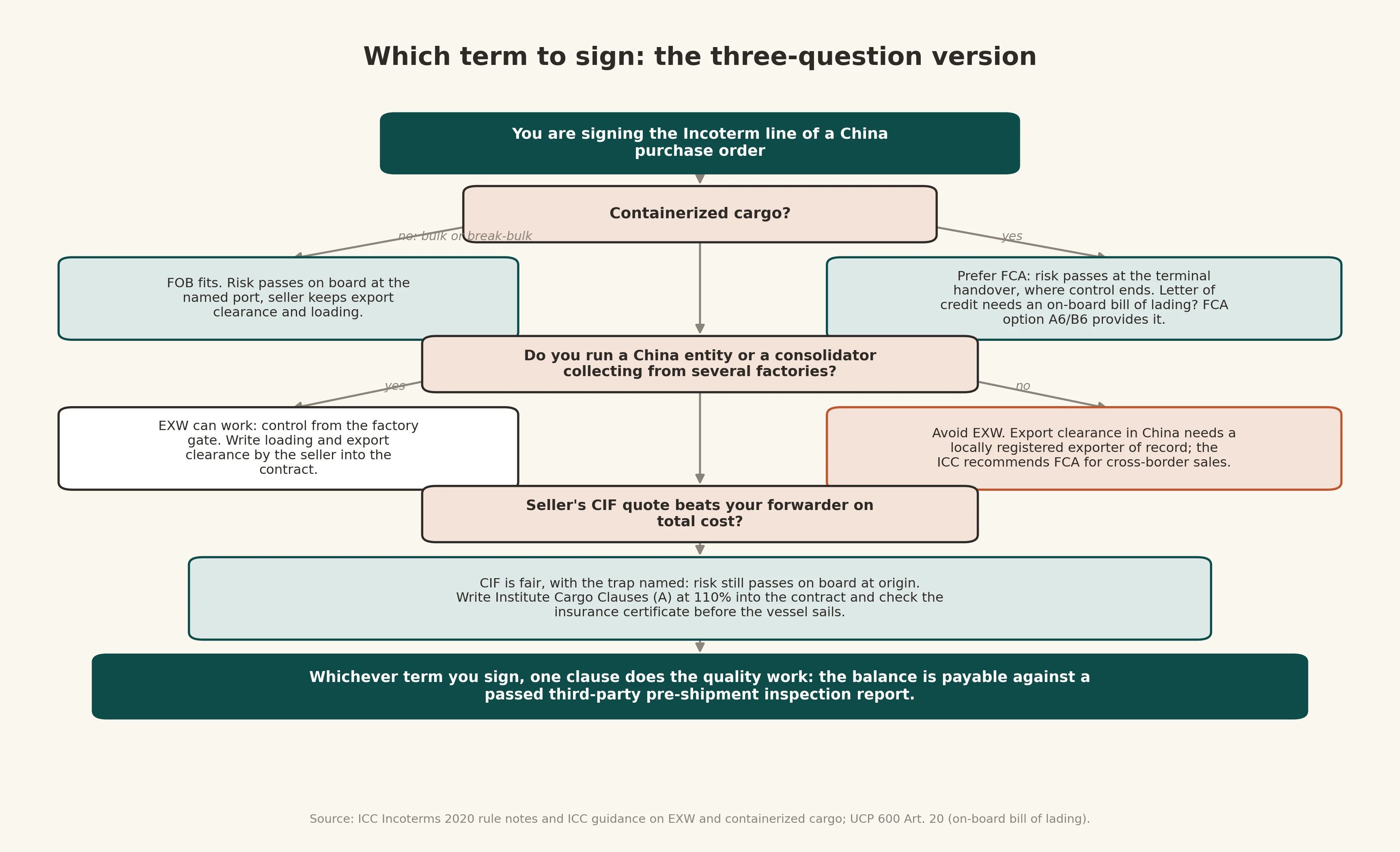
Figure 3. The signature decision, compressed. The term choice changes who loads, who clears export, and who insures; it does not change where conformity is decided, which is the factory floor, before the goods move. Positions per ICC Incoterms 2020 and the ICC's containerized-cargo guidance.
7. Fairness: when EXW or CIF is the right signature
EXW has real uses. A buyer with its own China office or a contracted consolidator collecting from several factories into one container wants goods released at factory gates, wants its own forwarder controlling everything from the gate, and can handle the exporter-of-record problem with its own licensed entity. For that buyer, EXW is the honest term: no pretending the seller controls what it does not. The failure mode is the small first-time buyer signing EXW because the unit price looked lowest, then discovering the loading risk, the clearance problem, and the forwarder markup on origin costs one invoice at a time.
CIF has real uses too. Bulk and commodity trades run on it because cargo is sold in transit and documents matter more than control. A small buyer without freight relationships sometimes gets a better all-in price from the seller's contracted rates than from its own forwarder quote. The failure mode is reading "seller pays insurance" as "seller carries the risk," and discovering after the water damage that the policy is Clauses (C) and the risk was yours from the load port.
FOB (or FCA for containers) remains the term that matches how consumer goods move out of China: the seller handles what it can see (its factory, its trucking, its customs filing), the buyer controls the voyage and the insurance, and the risk line sits at a point both parties can document. It is also the term under which a pre-shipment inspection sits most naturally: findings land while the seller still bears the risk, and rework on the seller's side of the line is the expected outcome, not a negotiation.
8. The math of getting it wrong
The expensive versions are documented patterns, not inventions:
- The forfeited claim. Defects surface in week six after arrival. Article 38 examination window and the case-law notice range (roughly one to four weeks in the reported decisions) have run. The buyer's remedies under the CISG are gone regardless of the defect's reality. What remains is goodwill negotiation with a seller who has already been paid in full.
- The uninsured casualty. CIF shipment, container takes on water in heavy weather, cartons and product ruined. Clauses (C) does not respond to weather water damage; the claim is declined. The loss is the buyer's in full, and the seller performed its only insurance obligation by buying the minimum policy.
- The unfunded argument. FOB container handed to the terminal Monday, damaged in the yard, loaded Thursday. The seller's risk on paper, the seller's absence in practice, and a buyer learning what a terminal-gap dispute costs in legal fees against the value of one container.
- The invisible exporter. EXW order, no local entity; the forwarder's borrowed exporter of record files with mismatched figures; customs holds the cargo; demurrage and delay costs belong to the buyer, because under EXW export clearance was the buyer's obligation all along.
Against those, the cost of the evidence is a one-day inspection at the flat man-day rate. The asymmetry is the same one the review-wave article priced for Amazon listings: a small certain cost at the only moment the defect distribution can still be changed, versus a large probabilistic cost after every lever is gone.
9. Where this ends
Honest limits, three of them. First, we are inspectors, not your lawyers; the CISG sections above describe the default rules and the published case-law ranges, and a dispute you face wants a trade attorney reading your own contract. Second, Incoterms and the CISG both yield to the contract: parties can, and do, vary almost everything discussed here, so the paper you signed beats the pattern in this article. Third, neither instrument fixes a seller who will not perform; an inspection clause and a report give you evidence and a payment gate, and arbitration or litigation is still what enforces them if the seller walks.
FAQ
Does CIF mean the seller is responsible for damage during shipping? No. Under CIF the risk passes to the buyer when the goods are on board at the port of shipment, the same point as FOB. The seller must buy insurance for the buyer's benefit (minimum Institute Cargo Clauses (C), at least 110% of contract value), and the buyer files the claim if the voyage goes wrong.
Is FOB safe for container shipments from China? It is standard practice but technically mismatched: containers are handed to the carrier at a terminal days before loading, while FOB risk stays with the seller until on board. The ICC recommends FCA for containerized goods; Incoterms 2020 added an FCA option (A6/B6) that preserves the on-board bill of lading letters of credit require.
Which Incoterm gives me the best chance to inspect before paying? All three allow it if the contract says so. FOB and CIF are friendlier because the seller still bears risk when the inspection happens at the factory; under EXW the inspection must finish before your carrier collects, because risk passes at the factory gate.
Does the CISG apply to my purchase order from a Chinese factory? If both businesses have their places of business in contracting states (the US and China are both members, since 1988) and the contract does not expressly exclude the CISG, it applies by default, even without being mentioned. A "governed by New York law" clause does not exclude it.
How long do I have to complain about defects under the CISG? Article 38 requires examination within as short a period as is practicable; Article 39 requires notice within a reasonable time after discovery, with a two-year outer limit from handover. Reported decisions treat reasonable time as roughly one to four weeks depending on the goods. Waiting is how valid claims die.
Does cargo insurance cover defective products? No. Marine cargo insurance responds to transit casualties. Defects present at loading are excluded (inherent vice, Institute Cargo Clauses 4.4) and belong to the seller as a conformity breach under CISG Article 36, which is why evidence from before the risk line decides the argument.
What is the single most common Incoterms mistake on China orders? Writing "FOB China" or "CIF USA" with no exact port and no edition. The named place is where the risk line sits; without it, the contract cannot say where delivery happened, and a judge or arbitrator decides instead.
If I can only change one clause, which one? The payment clause: balance payable against a passed third-party inspection report. It works under EXW, FOB, and CIF alike, because it lives in the contract, above the Incoterm.
Sources
- International Chamber of Commerce, Incoterms® 2020 (ICC Publication No. 723E, in force January 1, 2020): risk-transfer points for EXW, FOB, CIF; CIF insurance minimum (Institute Cargo Clauses (C), 110% of contract value, buyer as beneficiary); FCA recommendation for containerized cargo and the FCA A6/B6 on-board bill of lading option; guidance that EXW was drafted mainly for domestic trade.
- International Chamber of Commerce, Incoterms 2010: risk point for FOB/CFR/CIF moved from the ship's rail to on board.
- United Nations Convention on Contracts for the International Sale of Goods (1980, in force 1988): Articles 35, 36, 38, 39, 40, 44; Article 67 default risk rule for carriage sales; Article 6 opt-out. UNCITRAL status table: 97 contracting states (2026); US and China parties since 1988; both hold Article 95 reservations; China withdrew its Article 96 declaration in 2013.
- UNCITRAL Digest of Case Law on the CISG, and CISG Advisory Council Opinion No. 2, Examination of the Goods and Notice of Non-Conformity (2004, rapporteur Eric E. Bergsten): examination and notice practice under Articles 38 and 39; notice periods in the case law running from about one or two weeks to a month.
- F. G. Mazzotta, "Uniform Interpretation: Notice of Nonconformity," Journal of Law & Commerce, 2019.
- Pan Zhen, "China's Withdrawal of Article 96 of the CISG," University of Miami Business Law Review, 2016.
- Institute Cargo Clauses (C), LMA/IUA 2009 wording: named perils (fire, explosion, stranding, sinking, collision, jettison, general average); exclusions including delay (4.5) and inherent vice (4.4).
- ICC, UCP 600 (2007): Article 20 (on-board bill of lading), Article 28 (insurance document, 110% of CIF/CIP value where not stated).
- Import QC inspection dataset: twelve pre-shipment inspections, 81,071 units, 141 defective units in samples, about two-thirds reworked or replaced on site (aggregated in "The anatomy of a failed inspection," importqc.com Insights).
The way to put this into practice: whichever of the three terms is on your proforma invoice, the inspection and the balance clause do the same work. Import QC inspections run $149 per man-day flat, an inspector is on site within 48 to 72 hours anywhere in China, and the photo-documented report lands within 24 hours, dated before the goods move and before the money does. That is the evidence position this article described, purchased for less than the demurrage on one held container.
Related reading: The anatomy of a failed inspection, Pre-shipment inspection checklist, line by line, What a one-star review wave costs vs what an inspection costs, and the underlying documents in our sample reports library.