
The short answer: Chinese New Year 2027 falls on Saturday, February 6, and the date that decides your shipment is not February 6. It is your factory's last loading day, which lands two to four weeks earlier. China's official public holiday runs February 5 to 13, 2027 (State Council General Office notice, November 5, 2026), but most factories stop producing in the second half of January and do not return to full capacity until late February or early March. For goods that must ship before the break, the latest safe pre-shipment inspection windows are December 15 to 20, 2026 for Europe and the US East Coast, and January 7 to 10, 2027 for the US West Coast, assuming typical ocean transit and the usual factory wind-down pattern. Every other date in this guide counts backward from those.
This guide does three things: fixes the 2027 dates that are already fixed, prices the gap between the official nine-day holiday and the operational shutdown, and gives you the count-back math to place your own order on the calendar.
1. The situation: "we will finish before the holiday"
It is mid-November. Your purchase order has been running since October, and the supplier's latest message says production will finish before the holiday. The sentence is probably true, and it is nearly useless, because "finish," "load," "sail," and "arrive" are four different dates, and only the last one pays your invoices.
A factory that finishes your goods on January 25 has met its sentence. Your goods then sit while the lines empty, the forwarder's cutoff passes, the last workable sailings leave, and the container that was supposed to reach your warehouse in February reaches it in March. If the goods are also defective, you find out in March, and the rework window closed six weeks earlier.
The fix is not urgency. It is arithmetic: pick the date your goods must be on the water, and count backward.
2. Three calendars, and only one of them moves your goods
The lunar calendar is fixed. Lunar New Year's Day 2027 is Saturday, February 6 (Hong Kong Observatory conversion table; it is the Year of the Goat). New Year's Eve falls on Friday, February 5, because 2027 is one of five consecutive years in which the twelfth lunar month has only 29 days. The Lantern Festival, the traditional close of the season, is Saturday, February 20. Nobody negotiates these.
The official calendar is fixed too, and it is the least useful of the three. The State Council's 2027 holiday notice, published November 5, 2026, sets the Spring Festival break at nine days, Friday, February 5 through Saturday, February 13, with Sunday, January 31 and Sunday, February 14 as make-up working days. The notice tells you when government offices close. It says nothing about when your factory's lines stop.
The supplier's calendar is the one that moves your shipment. Each factory sets its own last production day, last loading day, and restart, and the operational shutdown is far wider than nine days. The pattern across sourcing, freight, and inspection practitioners is consistent: workers begin leaving one to three weeks before the Eve (they leave when the train ticket allows, not when the holiday begins), production lines wind down in the second half of January, most factories are fully closed for two to four weeks, and full capacity returns only in late February or early March, after the Lantern Festival. The total is roughly six weeks of lost or reduced output. In one forwarder's 2026 example, small and medium factories stopped production eleven days before New Year's Day; large factories stopped three days before. After the restart, lines come back with new hires in place of workers who did not return, and the first weeks of output carry a known yield dip.
Two features make 2027 specifically awkward. First, the holiday lands eleven days earlier than in 2026 (February 6 against February 17), which pulls every upstream deadline back with it. Second, the mid-January production stop arrives about two weeks after the Western New Year break, inside the fortnight when most importing teams are least likely to be watching a Chinese calendar. The deadline did not just move. It moved into your blind spot.
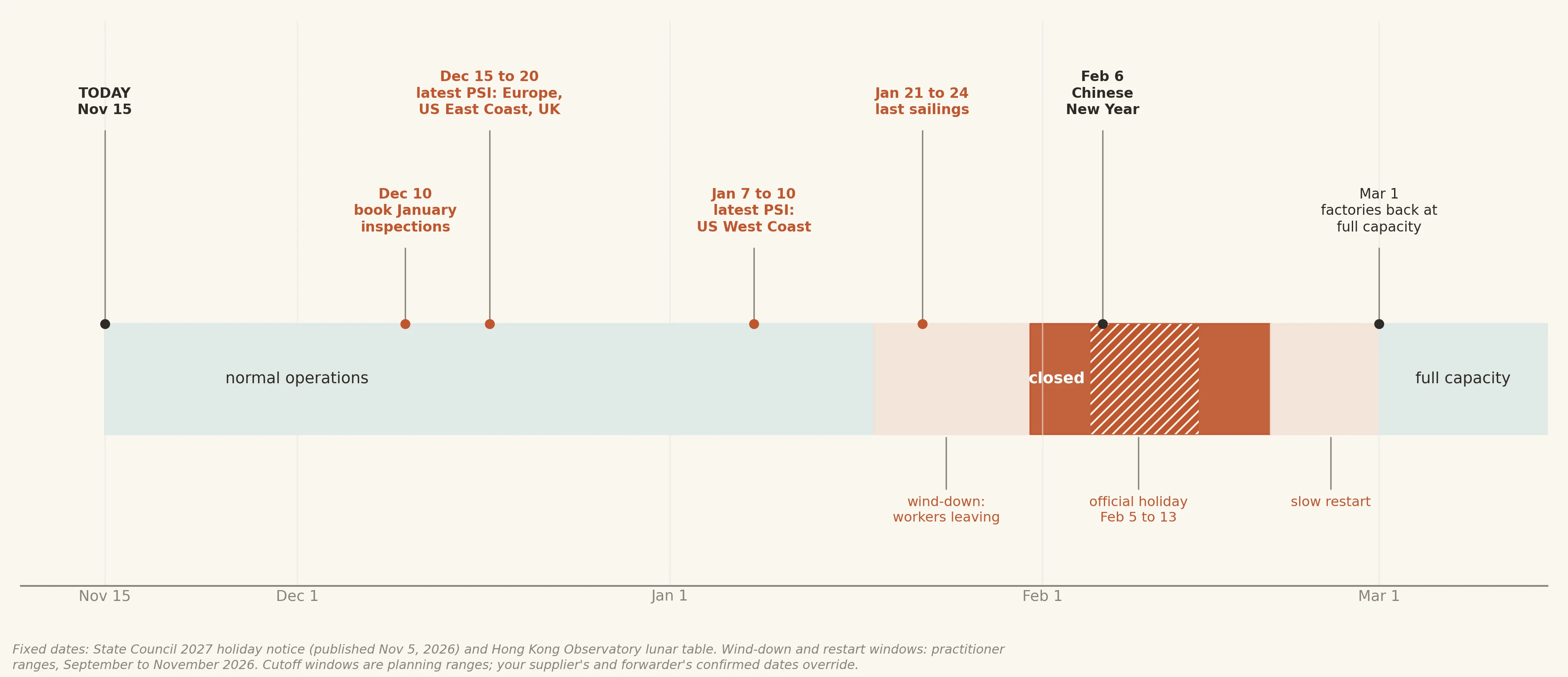
Figure 1. The 2027 season on one line. The fixed dates (official holiday February 5 to 13, New Year's Day February 6) sit inside a much longer operational shutdown. The dated markers are the deadlines a buyer controls; the bands are the ones the factory controls.
3. Why the last production weeks are where quality goes to die
The quality mechanism is worth understanding, because it is what makes the inspection dates in section 4 non-negotiable.
From about two months before the holiday, factories are under pressure from every buyer to get goods out before the break (a buyer-side pressure pattern documented in sourcing trade literature for years). Overtime rises, lines run at maximum utilization, and management attention shifts to collections and closing the year. From mid-January, the workforce thins as departures begin, and the workers remaining are often the ones finishing someone else's stations. Practitioner consensus across inspection companies is blunt: the final one to two weeks before the shutdown produce the worst quality of the year.
The second mechanism matters more for you. A pre-shipment inspection is only a lever while there is calendar behind it: time to rework, time to re-inspect, time to load after a pass. A failed report on December 20 opens a procedure. The same failed report on January 25 opens a very different conversation, because there is no line left to rework on and no sailing left to catch. Your choices compress to two: accept the goods at a negotiated discount, or hold them and miss your season. The balance payment is still your bargaining power in that conversation (we covered that mechanism in the 30/70 article), but bargaining power is a worse tool than a rework window. The point of this guide is to make sure you never have to choose.
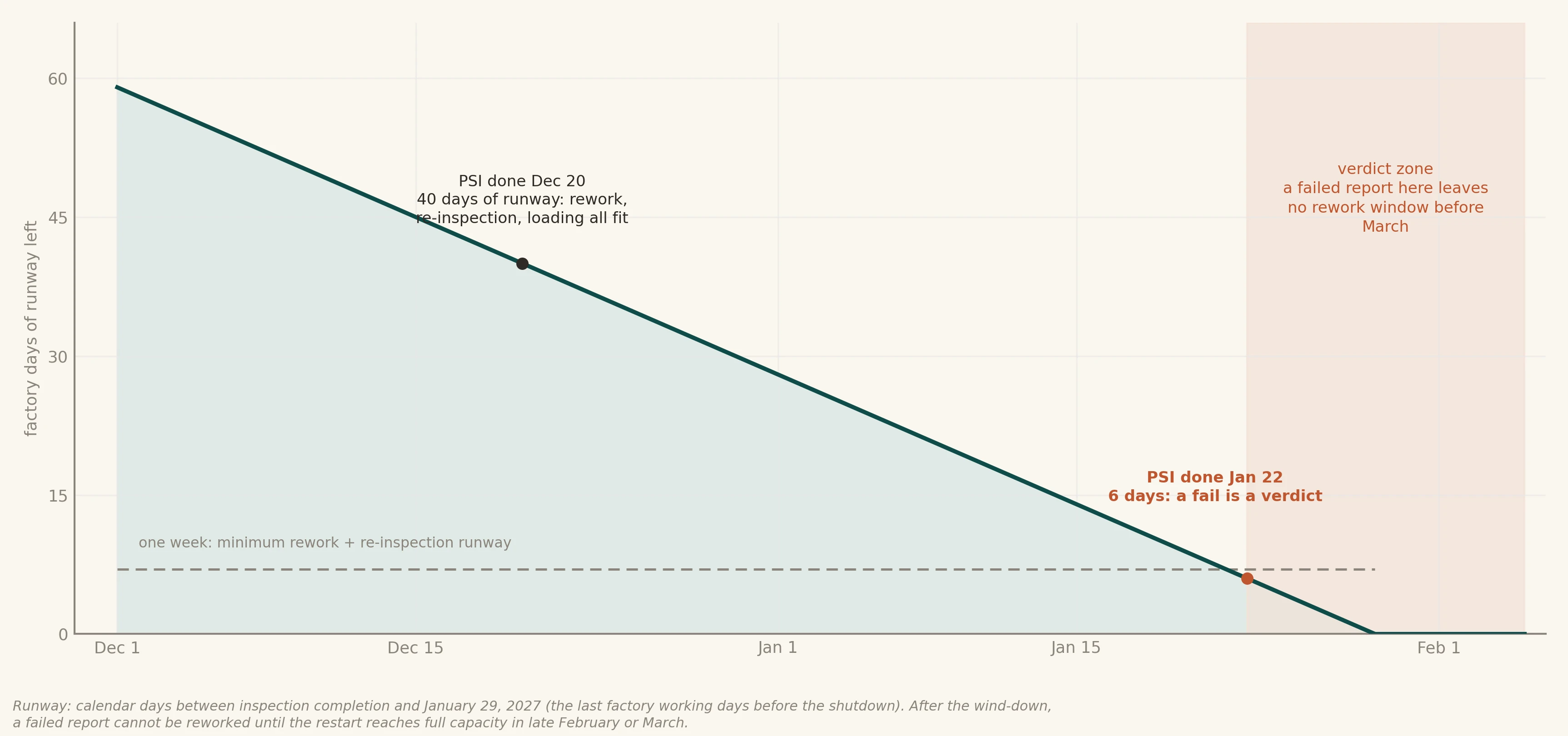
Figure 2. The runway calculation behind this section: calendar days between inspection completion and the last factory working days (January 29). An inspection completed by mid-December leaves room for the full fail-rework-recheck cycle; the same inspection in the last week of January leaves none.
4. The backward count: the dates that decide your shipment
Work backward from your destination. The planning ranges below consolidate current freight and inspection-industry guidance for the 2027 season; they are estimates, and your forwarder's live cutoffs and your supplier's written dates override them.
| Destination | Typical ocean transit | Latest vessel departure (ETD) | Latest factory release | Latest PSI completion |
|---|---|---|---|---|
| UK (Felixstowe / London Gateway) | 32 to 38 days | Dec 25, 2026 to Jan 1, 2027 | Dec 18 to 22, 2026 | Dec 12 to 18, 2026 |
| Europe (Rotterdam / Hamburg) | 30 to 35 days | Dec 27, 2026 to Jan 4, 2027 | Dec 20 to 25, 2026 | Dec 15 to 20, 2026 |
| US East Coast (New York / Savannah) | 30 to 35 days | Dec 27, 2026 to Jan 4, 2027 | Dec 20 to 25, 2026 | Dec 15 to 20, 2026 |
| US West Coast (LA / Long Beach) | 14 to 18 days | Jan 21 to 24, 2027 | Jan 10 to 14, 2027 | Jan 7 to 10, 2027 |
Then keep counting upstream:
- Inspection completion assumes a booked inspection. Our dispatch runs 48 to 72 hours and the report lands within 24 hours of the visit, but every buyer in China wants the same two January weeks, and inspection slots are the first scarcity of the season. Our working rule: book January inspections by December 10. The date the factory quotes you ("any time before we ship") is not a booking.
- Inspection completion also assumes finished goods. A standard pre-shipment inspection requires production 100% complete with at least 80% of units packed. Your production-complete date is your PSI date minus the booking lead time and at least a week of fail-and-rework buffer.
- Production-complete implies a deposit date. With a 30-day production lead, the deposit needs to land in early December for a mid-January finish. With a 45-day lead, the deposit deadline for a late-January finish lands around December 8. Longer than that, and the honest plan is a post-holiday delivery date, set now rather than after a month of drift.
- Freight space is its own deadline. The pre-holiday rush tightens vessel space and triggers carrier rate increases in the final weeks; booking late means paying more or getting rolled to a later sailing. Book January sailings in December.
The blunt read for mid-November: if your order is not yet placed, the ocean window for the UK, Europe, and the US East Coast is effectively closed (production would need to finish around December 20 to 25). The US West Coast window is still open, but only for orders placed now with production of about 30 days. Past mid-December, the bridge is air freight, at a multiple of the ocean rate, for the fraction of stock that genuinely cannot wait.
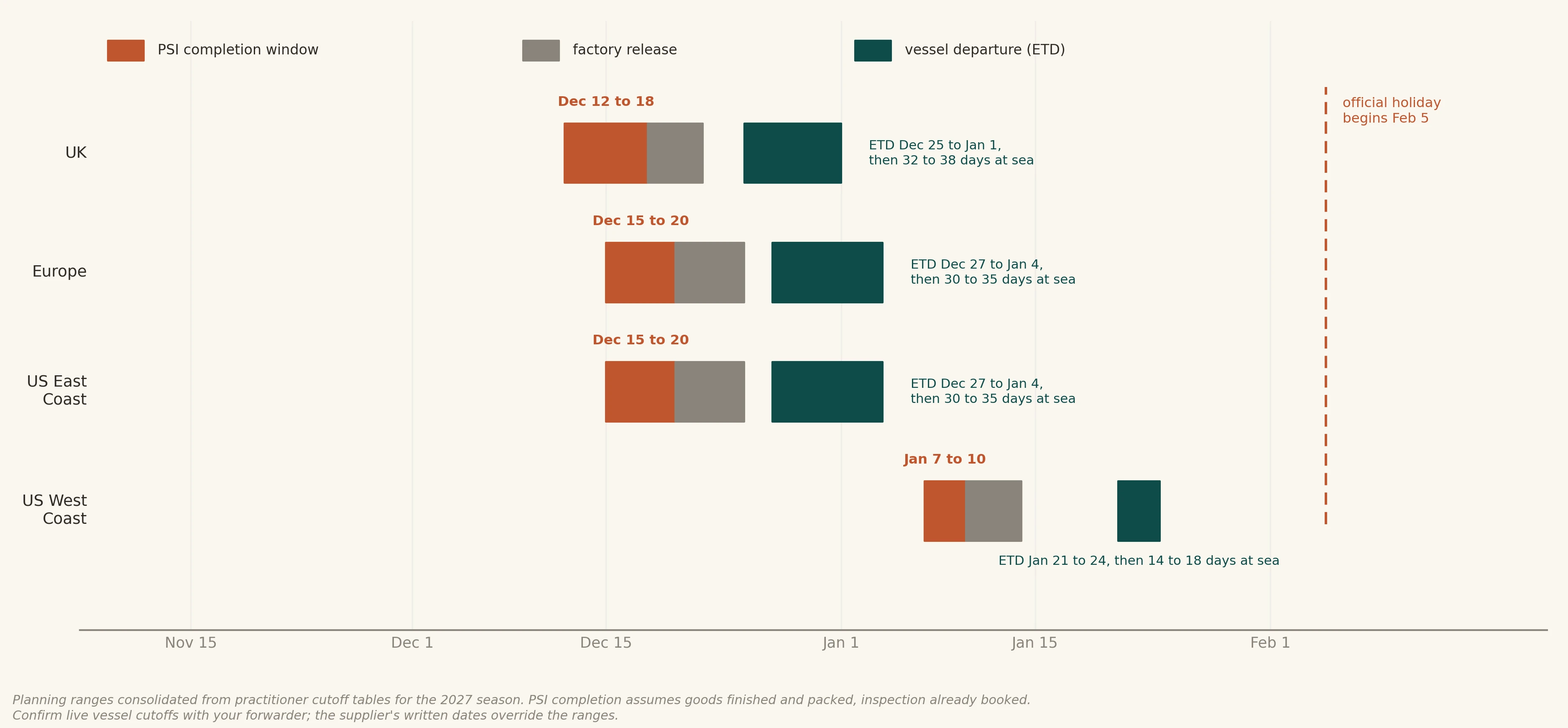
Figure 3. The table from this section as a timeline. Inspection first, then factory release, then the vessel; Europe and the US East Coast effectively close in December, the US West Coast stays open into the second week of January.
5. The un-copyable proof: what the calendar does to the inspection gate
Everything above is practitioner consensus. This section is ours.
Every one of the thirteen sample inspection reports in our public library ends with the same status word: "Pending." The inspection company never ships the goods and never releases the money; the report lays findings in front of the buyer, and the buyer decides. A decision takes days of calendar: read the report, query the supplier, agree a fix, confirm a re-inspection. In June those days are free. In the third week of January, the factory has no days left to sell you.
Our defect dataset (twelve pre-shipment inspections, 81,071 units, 141 defective units in the samples, aggregated in "The anatomy of a failed inspection") carries the statistic this season tests: about two-thirds of the defective units found were reworked or replaced during the inspection itself, on the factory floor, at the factory's cost. That number has a hidden precondition. On-site rework requires a line that is still running and workers still on it. Both exist in December. Neither reliably exists in the last week before the Eve.
The drawstring-bag report (May 2026, 6,000 pieces, 200 sampled) shows the other branch. It records two major defects and six minor, and states verbatim: "All defective products were not reworked or replaced on site." In May, that sentence starts a rework procedure. On January 22, the same sentence starts a negotiation about accepting defective goods or missing the season, conducted against a shutdown deadline, with your unpaid balance as the only thing keeping the factory at the table. The report does not change. The calendar decides what the report is worth.
6. The method: six moves, in order
- Get four dates in writing from each supplier, this week. Last production day, last loading day, restart date, and full-capacity date. Every practitioner guide says the same thing for a reason: the official holiday is fixed, the supplier's calendar is not, and a supplier who answers promptly with specific dates is telling you they are managed.
- Count your order backward per destination. Start from the table in section 4, not from the factory's reassurance. If the deposit has not landed and the math does not close, decide now between air freight for the launch-critical fraction and a post-holiday delivery date agreed in writing. A date chosen in November is a plan; the same date discovered in January is a surprise.
- Book the inspection by December 10, or two weeks before factory release, whichever is earlier. Name the standard in the purchase order (your specification plus the AQL level), so that "passed" means something and "failed" triggers a written procedure rather than a debate.
- Keep the balance payment against a passed report, and schedule so that a fail leaves runway. The full payment mechanism is in the 30/70 article; the calendar version of the rule is: a failed December report is a procedure, a failed late-January report is a verdict. Book for the procedure.
- If goods miss the last sailing, inspect them anyway, before the holiday. Do not let un-inspected goods sit in a factory warehouse for five weeks and arrive in March as a rumor. A report on file fixes the goods' condition while the goods and the workers are both still there; it is what makes a March conversation unnecessary, or winnable.
- Pre-book the first inspection after the restart for anything shipping in March. Restarted lines run with replacement workers and clearing backlogs, and the first weeks of output carry a documented yield dip. Post-holiday inspection demand spikes at the same time. March inspections booked in January behave like January inspections booked in December: they happen on schedule.
7. Fairness: when you can ignore this guide
The count-back is for orders that must arrive before your own season and suppliers whose track record is short. There are real cases on the other side. A repeat supplier with written dates and five clean orders has earned a looser rein. Small stock orders move by air anyway and follow a different calendar. And the wind-down itself is not a factory failing: the holiday is the one trip home of the year for most of the workforce, lines cannot run unstaffed, and a supplier who tells you honestly that your goods will finish March 10 is more valuable than one who promises January 25 and means "maybe." This guide prices the calendar. It does not assign blame for it.
8. The math of missing the window
A modeled scenario, assumptions stated: a $20,000 order, 2,000 units at $10, US West Coast destination, production finishing January 15.
Gated path. Inspection booked December 10, visit January 8, report January 9. At an 8.5% any-defect rate (our thirteen-report library's sample rate), assume the report fails the lot on a major defect. Rework takes three days on a running line, re-inspection passes January 14, goods release inside the January 10 to 14 window, vessel departs January 21 to 24, stock arrives mid-February. Total cost of the gate: the inspection fee and about four days.
Ungated path. The goods sail January 22 un-inspected to catch the last sailing, or the inspection happens January 20, fails, and ships anyway because the alternative is missing the season. At the same defect rate, about 170 units land defective in mid-February. Discovery happens at your 3PL. The recovery menu from the 30/70 article applies: a goodwill concession from a supplier holding 100% of the money, a platform dispute window if one applies, or formal proceedings priced out of reach at this order size. The season, meanwhile, does not wait: spring goods arriving defective in February get marked down, written off, or replaced by air at a multiple of the ocean rate.
The asymmetry is the whole argument: the same inspection is a cheap procedure in December and an expensive verdict in late January. The fee is identical. The calendar is what changes the price.
9. Honest limits
Four of them. First, every date here except the lunar ones is a planning range consolidated from practitioner sources, not a guarantee; your supplier's written dates and your forwarder's live cutoffs override the table. Second, closure patterns vary by region, industry, and factory size: electronics clusters, toy towns, and family-run workshops wind down on different schedules, and 2027's port congestion and blank sailings will move freight dates in December. Third, the guide assumes ordinary production orders; tooling-heavy custom work and new product introductions carry longer, less movable timelines, and practitioners advise against scheduling a new product introduction anywhere near the break at all. Fourth, sourcing around the holiday does not work: Vietnam closes for Tet in the same week (February 4 to 10 for the public sector), and Taiwan and Hong Kong run their own closures in the same window, so a regional backup does not offset a Chinese one.
FAQ
When is Chinese New Year 2027? Saturday, February 6, 2027, the Year of the Goat. New Year's Eve is Friday, February 5, and the Lantern Festival on Saturday, February 20 closes the season. China's official public holiday runs Friday, February 5 through Saturday, February 13, nine days, per the State Council notice of November 5, 2026.
How long do Chinese factories close for Chinese New Year 2027? Nine days officially; four to six weeks operationally. Production winds down from mid-to-late January as workers leave, most factories are fully closed for two to four weeks, and full capacity returns in late February or early March. Plan against the six-week band, not the nine official days.
What is the latest date for a pre-shipment inspection before CNY 2027? Planning ranges by destination: December 12 to 18, 2026 for the UK, December 15 to 20, 2026 for Europe and the US East Coast, and January 7 to 10, 2027 for the US West Coast. These assume typical transit times and standard wind-down; your supplier's and forwarder's confirmed dates rule.
Is it too late to order in mid-November for delivery before the holiday? For ocean freight to the UK, Europe, or the US East Coast, effectively yes: production would need to finish around December 20 to 25. The US West Coast is still reachable if the order is placed now and production takes about 30 days. Past mid-December, air freight is the remaining bridge.
My goods finish the week before the holiday. Should I still inspect? Yes, and before the holiday, not after. A report on file fixes the goods' condition while lines and workers are still present, keeps the balance-payment lever alive, and turns a post-holiday shipment from a rumor into a documented decision.
Does an inspection delay my shipment in the January crunch? The visit books within 48 to 72 hours and the report lands within 24 hours, so the inspection itself costs about two days. The delay risk lives in late booking (January slots are the season's first scarcity), not in the inspection.
Do Vietnam or Bangladesh avoid the shutdown? Vietnam does not: Tet falls in the same week, with the public sector off February 4 to 10 and factories commonly closed longer. Bangladesh works through Chinese New Year; its long breaks are the two Eids. A Vietnamese backup is not an offset for a Chinese closure.
What dates should I get from my supplier in writing? Four: last production day, last loading day, restart date, and full-capacity date. Add two of your own: the confirmed inspection date and the confirmed loading date for your order.
Sources
- State Council General Office, 2027 public-holiday notice (published November 5, 2026, via Xinhua): Spring Festival break Friday, February 5 to Saturday, February 13, 2027 (nine days); Sunday, January 31 and Sunday, February 14 designated working days. Cross-checked across two independent trade guides.
- Hong Kong Observatory lunar calendar conversion table: Lunar New Year's Day Saturday, February 6, 2027; New Year's Eve Friday, February 5 (the twelfth lunar month has 29 days in 2027); Lantern Festival Saturday, February 20, 2027.
- Hong Kong gazetted holidays (February 6, 8, 9, 2027); Taiwan DGPA holiday block (February 4 to 10, 2027); Vietnam Ministry of Home Affairs Tet break for the public sector (February 4 to 10, 2027).
- Practitioner planning ranges, consolidated from multiple freight, sourcing, and inspection-industry guides published September to November 2026: wind-down one to two weeks before the Eve; full closure two to four weeks; return to capacity late February to early March (about six weeks of lost or reduced output); workers leaving one to three weeks early; restart yield dip from replacement labor; a forwarder's 2026 example with small and medium factories stopping eleven days before New Year's Day; suppliers refusing pre-holiday orders from early December; buyer pressure on factories from about two months out; pre-holiday carrier rate increases and space tightening.
- Destination cutoff planning table (typical transits: US West Coast 14 to 18 days, Europe and US East Coast 30 to 35 days, UK 32 to 38 days; latest ETD, factory release, and PSI completion windows): consolidated practitioner planning estimates for the 2027 season, October to November 2026.
- Import QC operations and data: 48 to 72 hour dispatch, report within 24 hours, 12-hour free cancellation; thirteen-report sample library, all concluding "Pending" for buyer decision; twelve-inspection defect dataset (81,071 units, 141 defective units in samples, about two-thirds reworked or replaced on site); drawstring-bag report, May 2026, verbatim: "All defective products were not reworked or replaced on site."
The December 10 booking rule exists because January slots go first. An Import QC pre-shipment inspection runs $149 per man-day flat, an inspector is on site within 48 to 72 hours anywhere in China, and the photo-documented report lands within 24 hours, while your goods and the factory's calendar are both still there.
Related reading: The 30/70 payment split: why the balance payment is your quality lever, FOB vs EXW vs CIF: which Incoterm puts inspection risk on whom, Pre-shipment inspection checklist, line by line, and the underlying documents in our sample reports library.