
The short answer: A 30/70 payment split is the default payment structure in Chinese manufacturing: the buyer wires 30% of the order value when the purchase order is confirmed, and the remaining 70% at an agreed trigger near the end of production. The split protects a buyer only if the trigger for the 70% is a document the buyer controls, and the strongest such trigger is a passed third-party pre-shipment inspection report. The reason is mechanical. The balance is the only payment that arrives after quality exists and before the goods are gone, so it is the one moment the buyer can still compel rework, replacement, or a price concession. Wired on the supplier's word alone, the balance converts a quality problem into a cross-border collection problem, where recovery runs through a legal system that treats most advance payments as refundable at best, through arbitration measured in months, and through wire transfers that banks cannot recall once settled. The ratio was never the protection. The condition attached to the 70% is.
This article prices that condition: what the split is, why the economics of hold-up make the balance decisive, what Chinese law does with a wired balance, what our own inspection reports look like at that gate, and the clause that closes the gap.
1. The situation: "goods ready, please arrange the balance"
The purchase order is $20,000. Six weeks ago you wired $6,000. Production photos arrived on schedule, the supplier's messages are friendly, and this morning's email says the goods are packed and asks you to arrange the $14,000 balance so the container can be booked.
Everything you will ever know about this order's quality for free is knowable in the next five days. After the wire, quality knowledge costs legal fees.
Most first-order buyers experience this as a logistics step. It is the opposite: the single decision point of the entire transaction. Every later instrument (the contract, the CISG, Trade Assurance, arbitration) is a remedial instrument, slower and weaker than the one you are holding right now, which is an unpaid invoice.
2. What the 30/70 split is, and why it exists at all
The structure is a commercial habit, not a rule. Across current buyer-side sourcing guides, 30% deposit on order confirmation with the 70% balance before shipment remains the default first-order structure Chinese factories quote in 2026, essentially unchanged for years, with common variants at 20/80, 50/50, milestone splits like 30/40/30, and "against bill of lading copy" triggers for more established relationships. A 100% upfront demand on a production order is a standard warning sign.
The split exists because both sides are holding a hostage problem. The factory spends real money before your goods exist: raw materials, a production slot that could have gone to another buyer, sometimes tooling. The deposit covers that outlay and walks back some of the factory's cancellation risk. On the other end, a small Chinese factory that ships goods before collecting has almost no way to recover payment from an overseas buyer; holding the goods until the balance clears is its version of control. Holding the balance until the goods pass inspection is yours.
Two mechanics of the payment itself matter here. A T/T wire is bank-to-bank settlement: it costs $25 to $50, takes one to three business days, and is final. There is no chargeback, no dispute mechanism, no recall once the funds are credited. The recovery instrument that does exist for wires, the FBI's IC3 Recovery Asset Team and its Financial Fraud Kill Chain, froze $561.6 million of $848.4 million in 2024 at a 66% success rate, but it exists for fraud: a supplier who took your money and delivered bad goods has breached a contract, not committed wire fraud, and no bank freezes a commercial counterparty's account over a quality disagreement. The wire's finality is why the decision has to be made before it, not after.
3. The mechanism: hold-up economics in one order
The academic frame for this situation is forty years old and fits it precisely.
Klein, Crawford and Alchian (1978, Journal of Law and Economics) described the hold-up problem: once one party has made a specific investment it cannot take back, the other party can renegotiate from strength, because the first party's alternative to a bad deal is losing the investment entirely. In a China order, the buyer's specific investment is the deposit plus six weeks of waiting plus a selling season planned around the goods. The factory knows all three. After the balance is wired, the direction of hold-up reverses fully: the factory holds all the money, the goods have not shipped or already have, and the buyer's alternative to accepting the supplier's offer is a legal process in another country.
Williamson (1983, American Economic Review, "Credible Commitments: Using Hostages to Support Exchange") gave the mechanism its name. Parties to a trade support their promises by posting hostages: value that one side forfeits if it misbehaves. An unpaid 70% balance is a textbook hostage. While it is unpaid, a factory that ships defective goods forfeits the majority of the order value, so its incentive is to fix what the inspector finds, on site, at its own cost. The moment the balance clears, the hostage is released, and the factory's remaining incentives are reputation and repeat business, which matter to good factories and not at all to bad ones. The entire art of payment terms is keeping the hostage posted until quality has been verified by someone who answers to you.
One more academic observation, from Macaulay's classic 1963 study of how businesses deal with each other (American Sociological Review): commercial parties mostly do not enforce contracts; they enforce relationships, and use formal rights as background pressure. That describes healthy repeat ordering accurately, and it is why the balance gate matters most where the relationship is thinnest: the first three orders, a new product, a new line. Relationship enforcement grows with order history. Until it exists, the balance is the relationship.
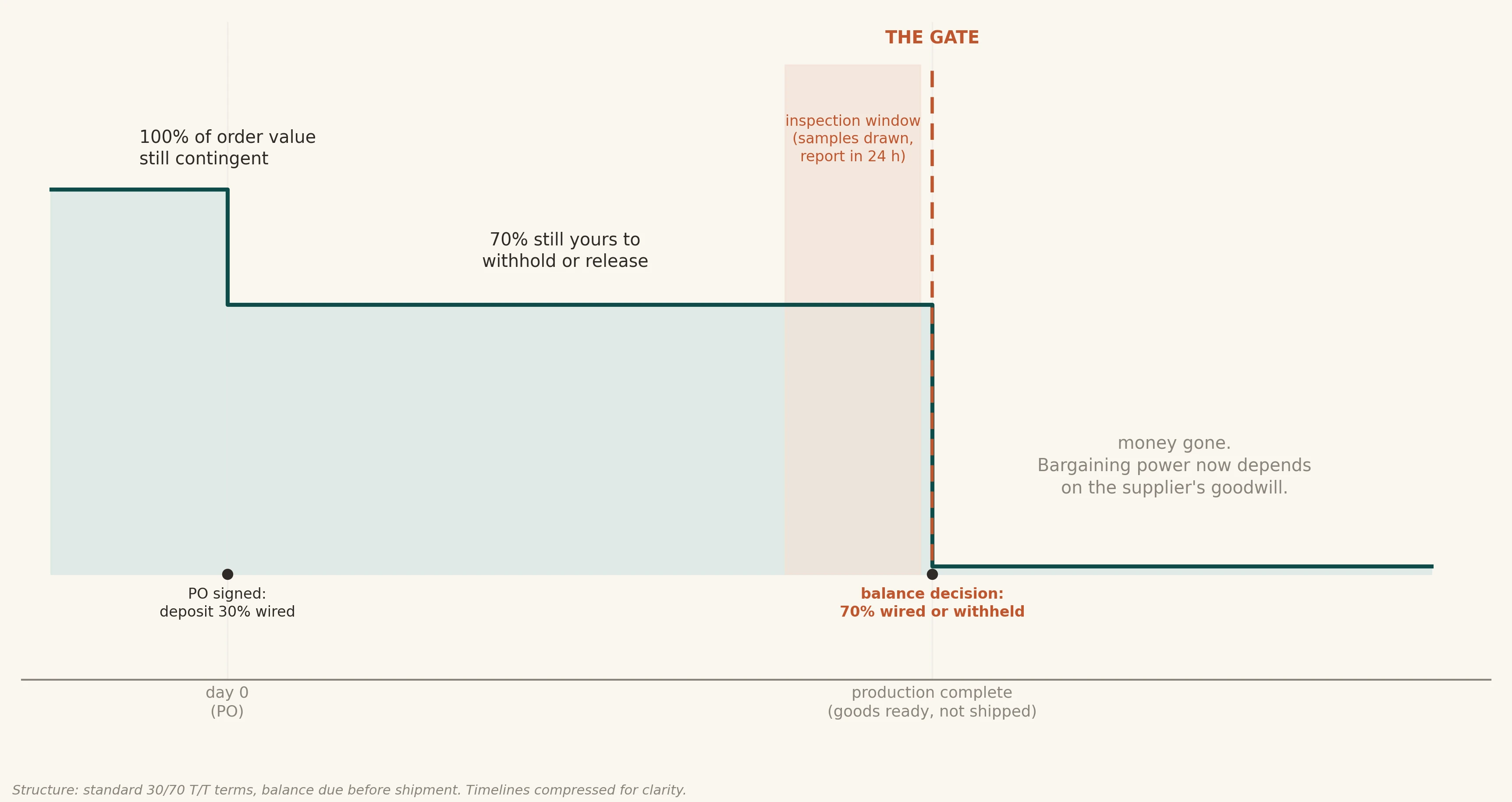
Figure 1. One order, two tracks. Top: when the money moves under a standard 30/70 T/T split. Bottom: what the unpaid 70% can still compel at each stage. The inspection window sits in the last days when the money and the goods are both still on the buyer's side of the table. Stages and durations are representative, not to scale; payment mechanics per the 2026 sourcing guides in the Sources.
4. What the law does with a wired balance
If the gate fails and the money is gone, three layers of law become relevant, and each is weaker than the invoice you were holding.
Chinese contract law distinguishes deposits from prepayments, and your "deposit" is probably a prepayment. Under Articles 586 and 587 of the PRC Civil Code, a statutory deposit (定金, dingjin) agreed as security is capped at 20% of the contract value; a paying party that breaches forfeits it, and a receiving party whose breach defeats the contract's purpose must return double. But Chinese practice separates that statutory deposit from an ordinary advance payment (预付款, yufukuan), which is refundable at best, with damages limited to foreseeable losses (Arts. 566, 584). Courts decide from the contract's wording and the parties' conduct, and a proforma invoice that says "deposit" in English, without the Chinese term, does not automatically create the double-return right. The practical read: the 30% you already paid buys you less legal protection than the word suggests, and the 70% you have not paid is where your actual power sits.
The clock is generous, the process is not. The limitation period for claims on an international sale of goods contract is four years (Art. 594), interrupted and restarted by a documented demand or the supplier's written promise to perform (Art. 195). But the path itself runs through arbitration (commonly six to eighteen months to a final award) or litigation (one to three years), with Chinese-language proceedings in court and enforcement abroad through the New York Convention. Practitioner consensus across China-sourcing legal guides is that formal recovery is rarely economical below roughly $50,000 in dispute. For a $14,000 balance on a $20,000 order, the legal layer is a paper remedy.
The CISG still applies, and it has a fuse. As covered in detail in our Incoterms article, the CISG governs US-China goods sales by default and makes the seller liable for defects that existed when risk passed, but the buyer must examine the goods as soon as practicable and give notice within a reasonable time, measured in weeks in the case law, with a two-year outer limit. The treaty gives you rights; it also schedules their expiry. A balance wired without an inspection starts a fuse you cannot see, on goods you have not examined, in a warehouse four weeks away.
The pattern across all three layers is the same: every post-payment remedy is slower, narrower, and more expensive than the pre-payment gate. That is the whole argument for treating the balance as a quality instrument rather than a payment milestone.
5. The un-copyable proof: what the gate looks like from inside
Every one of the thirteen sample inspection reports in our public library concludes with the same status word: "Pending." That is deliberate design. The inspection company never ships the goods and never releases the money. The report lays findings in front of the buyer while the balance is still unpaid, and the buyer decides. The gate is the buyer's, staffed.
What happens at that gate, in our own defect dataset (twelve pre-shipment inspections, 81,071 units, 141 defective units in the samples, aggregated in "The anatomy of a failed inspection"): about two-thirds of the defective units found were reworked or replaced during the inspection itself. Not after a dispute, not after a partial refund negotiation: on the factory floor, by the factory, while the buyer's balance was still unwired. The hostage was posted, so the goods got fixed.
Two report rows show the mechanism at full resolution. The office-chair inspection (July 2026, 676 pieces, 80 sampled) found four minor defects, and the report records that all four were handled on site before the goods moved. The electric-blanket inspection (September 2026, 80 sampled) found five minor defects, all reworked and re-checked during the visit. Those are the quiet outcomes: the gate worked, the balance moved against conforming goods, and nobody needed a lawyer.
The drawstring-bag inspection (May 2026, 6,000 pieces, 200 sampled) is the gate's other direction. The report records two major defects and six minor, and states verbatim: "All defective products were not reworked or replaced on site." The buyer received that sentence with the balance still in their account. Whatever came next (renegotiation, sorting at the factory's cost, a cancelled order, an accepted-as-is discount) was negotiated by a party holding $14,000 the factory wanted, against evidence the factory could not dispute. Wired first and inspected never, the same batch arrives as the buyer's inventory, and the same conversation happens with the factory holding everything.
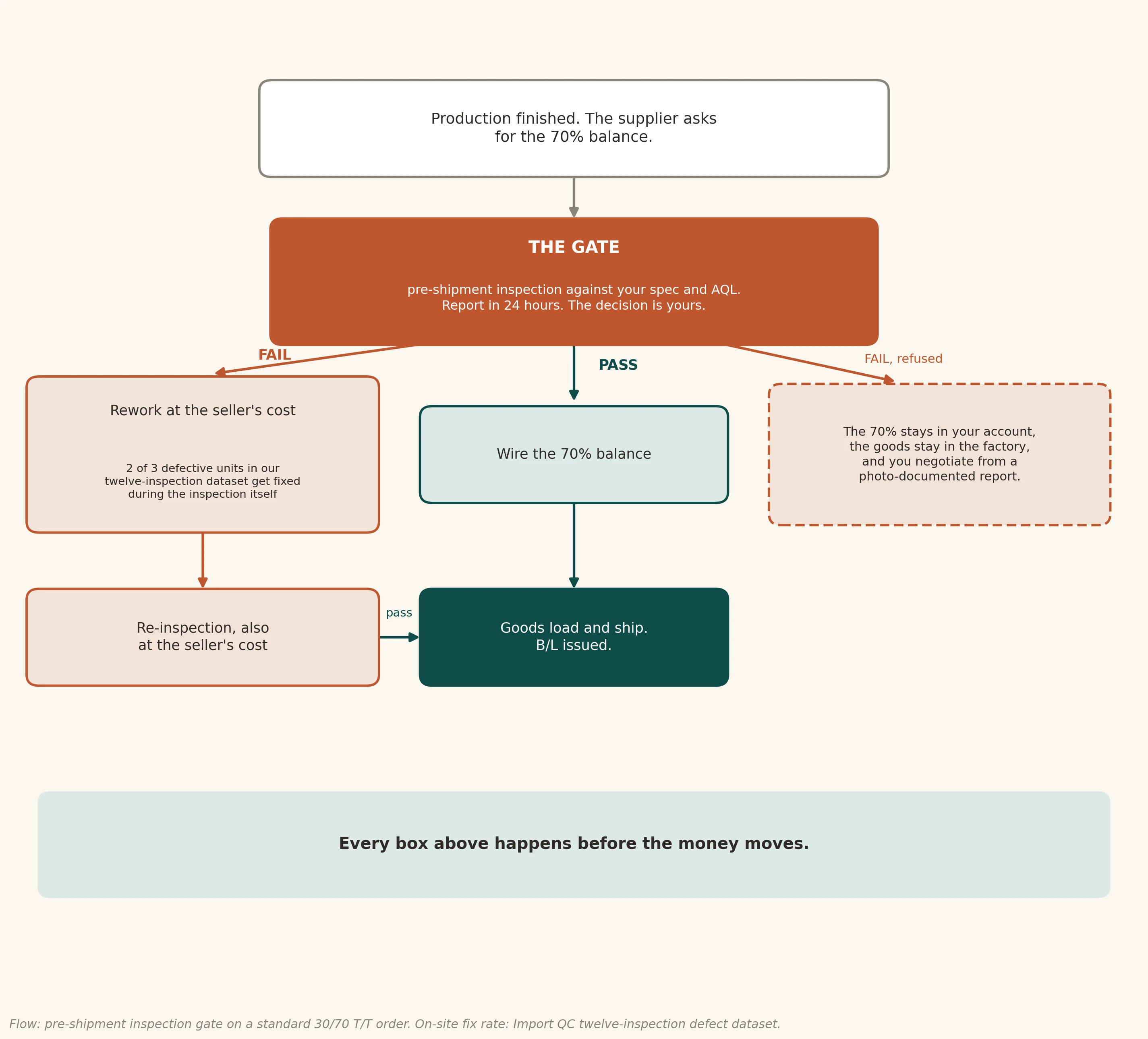
Figure 2. The gate, as a procedure. A passed report releases the balance against conforming goods. A failed report routes to rework at the seller's cost while the balance stays posted; about two-thirds of defective units in our twelve-inspection dataset were fixed during the inspection itself. Where the factory will not rework, the buyer negotiates from evidence with the money still unwired.
6. The method: turning the split into a gate
The fix is one clause plus sequencing, and it belongs in the purchase order before the deposit moves, because payment terms get harder to change after money and production are committed.
- Write the trigger. "Balance of 70% payable against a passed third-party pre-shipment inspection report, inspection booked by the buyer at the buyer's cost, against the attached specification and AQL standard." One sentence. It names the document, the inspector's independence, the standard, and the consequence.
- Write the failure path. "On a failed inspection, the seller reworks or replaces defective units at the seller's cost; a re-inspection follows, booked by the buyer at the seller's cost; the balance falls due against a passed re-inspection." Without this sentence, a failed report opens a negotiation. With it, a failed report opens a procedure.
- Decide the trigger with eyes open: before shipment versus against bill of lading. Balance against a B/L copy proves the goods shipped, which protects against non-delivery, but it proves nothing about what is inside the cartons, and it releases the money after the goods are gone. Balance against a passed inspection verifies content while the goods sit at the factory. On first and second orders, content is the bigger risk. On mature lanes, some buyers run both: inspection pass releases part of the balance, B/L copy releases the rest.
- Consider making the deposit a real deposit. If the order is large enough to justify bilingual drafting, agreeing the 20% as a statutory dingjin (定金) under PRC Civil Code Arts. 586-587 converts it from a refundable prepayment into a double-return instrument against a supplier who fails to perform. It cuts both ways (you forfeit it if you walk without cause), so it belongs on orders where you are as committed as you want the factory to be.
- Match the instrument to the order size. Under roughly $50,000, T/T 30/70 with the inspection gate is the working standard. Above it, add protection rather than switching blindly: staged balances (30/40/30 with a mid-production checkpoint), Trade Assurance's escrow where the platform applies (its dispute window runs about 30 days after delivery, its quality path requires a third-party inspection report, and payments wired off-platform are outside it entirely), or a letter of credit, where banks check documents before releasing funds. Each of these still needs the inspection report; escrow and LCs verify documents, not goods.
- Treat a refused inspection clause as information. A factory that will not accept "balance against a passed inspection" is telling you its plan for your defects. The refusal is the cheapest data point you will ever get about a supplier.
7. Fairness: when releasing the balance early is reasonable
The gate is for the phase where trust is unearned. There are real cases on the other side.
Repeat suppliers with a clean record have earned relationship enforcement: after five or ten clean orders, the factory's incentive to protect the lane is worth more than your hostage, and buyers commonly soften terms over time, toward 20/80 or against-B/L triggers. Samples, tooling, and small stock orders run 100% upfront as a matter of course, because the amounts do not justify a gate. Highly custom product sometimes justifies a larger deposit, because the factory genuinely cannot resell your materials. And the factory's fear is symmetrical and legitimate: once the container leaves, its collection prospects against an overseas buyer approach zero, which is why "balance before shipment" exists at all. The clause in section 6 does not ask the factory to ship on trust. It asks the factory to let an inspector look at the goods first, which is a much smaller concession than it sometimes sounds.
8. The math of getting it wrong
A modeled scenario, with assumptions stated: $20,000 order, 2,000 units at $10, balance $14,000 due on the supplier's say-so. Defect rate assumed at 8.5%, the any-defect sample rate across the thirteen reports in our current library (117 defective units in 1,376 checked). That projects to about 170 defective units.
Wire-first path. You discover the defects at your warehouse. The goods value at risk is $1,700, but the real cost runs wider: sorting or local rework at US labor rates (a multiple of the Chinese factory's cost for the same fix), discount-selling the seconds at a 30 to 50% markdown, or writing the units off. Against that, the recovery menu: a negotiated partial refund from a supplier who already holds 100% of the money, a Trade Assurance claim inside its roughly 30-day window if the platform applies and a third-party inspection report exists (you do not have one, which is how the quality path fails), or formal proceedings that practitioners price out of reach under about $50,000. Expected outcome, realistically: a goodwill concession of a few hundred dollars, or nothing.
Gate path. The inspection costs about one percent of the balance it gates. At an 8.5% defect rate the report fails the lot; two-thirds of defective units get fixed on site per our dataset, the rest get reworked or replaced under the clause, and the balance moves against a passed re-inspection. The factory absorbs the cost, because the hostage was posted.
The asymmetry does not depend on the exact percentages. Halve the defect rate and the conclusion survives, because the gate's price is two orders of magnitude below the balance it protects ($14,000), and the path divergence happens before the money moves.
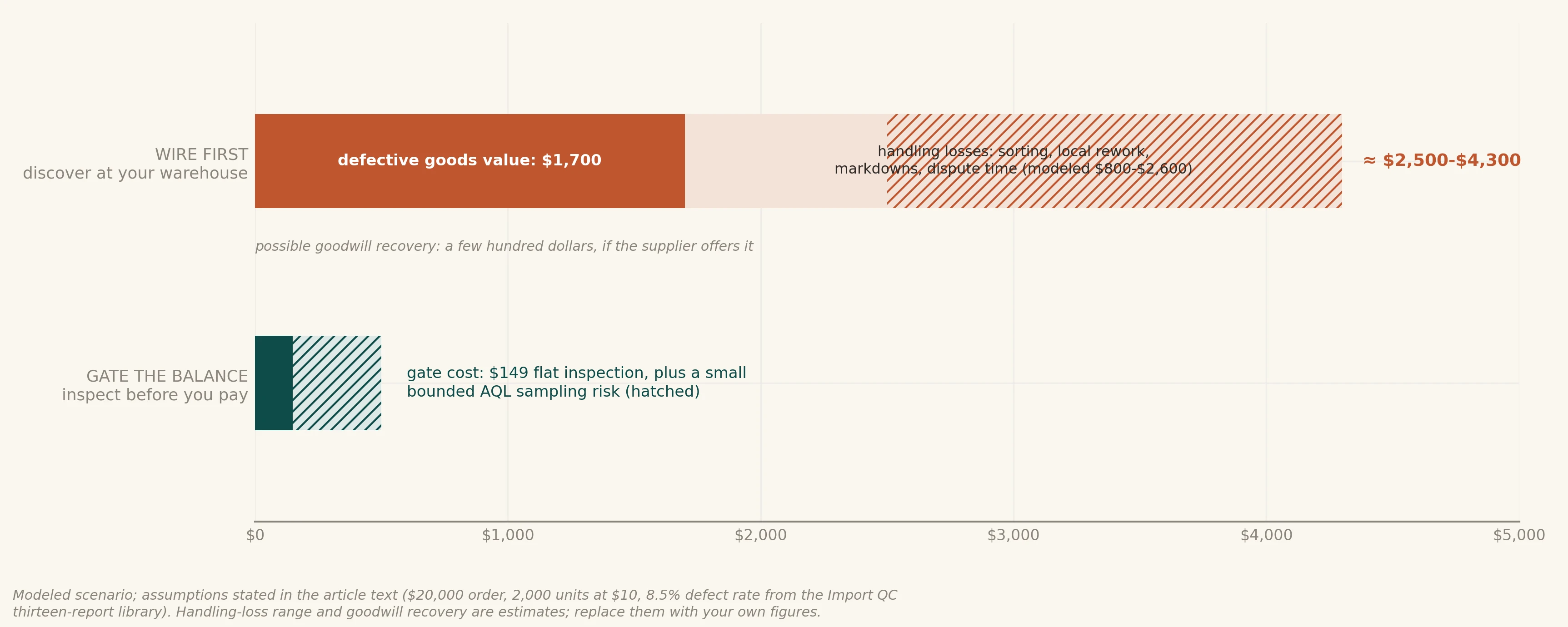
Figure 3. The modeled $20,000 scenario from this section, stacked. Every component of the wire-first bar is a stated assumption you can replace with your own figures; the gate bar's inspection line is the flat published rate. Assumptions: 2,000 units at $10, 8.5% defect rate (our thirteen-report library's sample rate), wire-first losses as described above, gate path with two-thirds of defective units fixed on site and the rest reworked under the clause.
9. Where the lever ends
Honest limits. First, the balance gate verifies a sample, not the universe: an AQL pass is a statistical statement, and a passed lot can still carry defects up to the acceptance limit (at AQL 2.5 major on a mid-size lot, a passing result is consistent with roughly 2.5% major-defective units shipped). The gate caps the rate; it does not zero it. Second, the lever works on money, not on intent: it cannot make a factory produce quality, only make defects expensive for the factory at the one moment fixing them is cheap. Third, the lever ends at shipment even when used perfectly, and what happens after the goods move (transit damage, insurance, Incoterm risk lines) is a different instrument's job; the Incoterms article maps that boundary. Fourth, none of this is legal advice: the Civil Code positions above are default rules, and a real dispute wants a Chinese-trade lawyer reading your documents.
FAQ
Is 30/70 negotiable with a Chinese factory? Yes, both the ratio and the trigger. Common moves: 20/80 on repeat orders, staged 30/40/30 for large custom runs, and the trigger shifted from "before shipment" to "against a passed inspection" or "against B/L copy." Factories move most readily on the balance trigger and split shipments; the deposit percentage on a first order is the hardest term to move.
What does my 30% deposit legally protect? Probably less than the word suggests. Under the PRC Civil Code, only an expressly agreed statutory deposit (定金, dingjin) carries the double-return penalty against a non-performing supplier, capped at 20% of contract value. Most advance payments on English-language proforma invoices are prepayments (预付款), refundable at best with foreseeable-loss damages.
Can my bank recall a wire to China if the goods turn out bad? No. A settled T/T wire is final, and quality disputes are commercial matters, not fraud. The FBI's kill-chain freezes (66% success on $848.4 million in 2024) apply to fraudulent wires reported within hours. A supplier who shipped defective goods under a real contract is outside that system.
Does Trade Assurance make the inspection clause unnecessary? No. Trade Assurance holds funds in escrow and its dispute window runs about 30 days after delivery, but the quality-claim path requires a third-party inspection report, and any payment wired off-platform is outside the program. The clause and the escrow work the same side: both need the report.
Is "balance against B/L copy" good protection? It proves the goods shipped; it says nothing about what is inside them. It protects against non-delivery, not against defects. For content risk, the inspection trigger is the stronger one, and the two can be combined.
What if the factory refuses an inspection-before-balance clause? Treat the refusal as the cheapest supplier-screening data point available. Factories with nothing to hide accept the clause routinely, because the inspection also protects them from post-arrival disputes.
When should I move from T/T to a letter of credit? Practitioner guidance puts the zone above roughly $50,000 to $100,000, where bank fees (typically 1.5% to 3%) buy document-checked payment. An LC verifies documents, not goods, so the inspection clause stays.
Does the gate slow down my shipment? An inspection books within 48 to 72 hours and the report lands within 24 hours of the visit, so the gate adds roughly two days at the exact point where a problem is cheapest to fix. A failed lot with on-site rework costs less time than a dispute after arrival.
Sources
- Current buyer-side sourcing practice (2026 guides, multiple): 30/70 T/T as the default first-order split; deposit funds materials and line setup; trigger options (before shipment, after inspection, against B/L copy); variants 20/80, 50/50, 30/40/30; wire fees $25 to $50, one to three business days; formal recovery rarely economical below about $50,000.
- B. Klein, R. G. Crawford and A. A. Alchian, "Vertical Integration, Appropriable Rents, and the Competitive Contracting Process," Journal of Law and Economics 21(2), 1978 (the hold-up problem; verified via the scholar plugin).
- O. E. Williamson, "Credible Commitments: Using Hostages to Support Exchange," American Economic Review 73(4), 1983 (payment as hostage; verified via the scholar plugin).
- S. Macaulay, "Non-Contractual Relations in Business," American Sociological Review 28(1), 1963 (relationship enforcement versus formal contract).
- PRC Civil Code (2021): Arts. 586-587 (statutory deposit/dingjin, 20% cap, double return), Art. 588 (election between deposit penalty and liquidated damages), Arts. 566, 584 (restitution and foreseeable-loss damages for prepayments), Art. 594 (four-year limitation, international sale of goods), Art. 195 (limitation interruption); SPC Contract Interpretation (2023). Practitioner summaries cross-checked against the Supreme People's Court publication.
- FBI IC3, 2024 Internet Crime Report: Financial Fraud Kill Chain, 3,020 complaints, $848.4 million attempted, $561.6 million frozen, 66% success rate; BEC context (fraud, not commercial disputes).
- Alibaba Trade Assurance program documentation and 2026 practitioner reviews: escrow structure, roughly 30-day post-delivery dispute window, quality claims require third-party inspection evidence, off-platform wires unprotected.
- CISG Arts. 38-39 (examination and notice clocks), as treated in detail in "FOB vs EXW vs CIF: which Incoterm puts inspection risk on whom," importqc.com Insights, 2026.
- Import QC inspection library (13 sample reports, October 2026): all reports conclude "Pending" for buyer decision; sample-checked totals 90,555 units, 1,376 units checked, 117 defective units (8.5% any-defect sample rate). Import QC defect dataset (12 pre-shipment inspections, 81,071 units, 141 defective units, about two-thirds reworked or replaced on site), aggregated in "The anatomy of a failed inspection." Chair report (July 2026): four minors handled on site. Blanket report (September 2026): five minors reworked and re-checked. Bag report (May 2026), verbatim: "All defective products were not reworked or replaced on site."
The clause in section 6 is free to copy. What it triggers is not expensive: an Import QC pre-shipment inspection runs $149 per man-day flat, an inspector is on site within 48 to 72 hours anywhere in China, and the photo-documented report lands within 24 hours, while the balance is still yours to hold.
Related reading: FOB vs EXW vs CIF: which Incoterm puts inspection risk on whom, Pre-shipment inspection checklist, line by line, What a one-star review wave costs vs what an inspection costs, and the underlying documents in our sample reports library.