
The short answer: Container loading supervision (CLS) is a third-party inspector standing at the container while your goods are loaded: checking the empty box before anything goes in, tallying cartons against the packing list as they cross the threshold, opening cartons at random to confirm the goods inside are the goods you inspected, watching the stowage, and photographing the seal before the doors close. Buyers who skip it assume the pre-shipment inspection already covered this part. It did not. The PSI verified your product; it said nothing about what physically enters the container, what condition the container is in, or how the load will survive four weeks at sea. The five failure modes below all live in that gap, and every one of them is invisible until the container is opened at your destination, when the cheapest moment to fix it is thirty to forty days in the past.
The legal punchline comes first, because it changes how you read the list: under the liability conventions that govern ocean freight, a full container of goods can be worth less to a carrier than a single pallet of it, and damage caused by bad loading is usually the shipper's problem, not the carrier's. The claim system will not save you. Presence at the loading dock is the whole game.
1. The situation: passed inspection, sealed container, wrong assumptions
Tuesday: the PSI report comes back passed. Wednesday: the balance moves under your 30/70 terms. Friday: the factory loads the container, the truck leaves the yard, and the forwarder sends you a bill of lading. Everything in that sentence is normal, and everything in it is unwitnessed.
Between the passed report and the sealed door, the goods change hands, the cartons cross a dock, and the only people counting, choosing, and stacking them work for the party you just paid in full. Most factories run this honestly. The failure modes below are not mostly fraud; they are mostly sloppiness, haste, and weather, which is worse news, because sloppiness does not need a motive and therefore does not need a suspicious supplier. It only needs nobody watching.
2. The five failure modes
2.1 The count that leaves is not the count you paid for
A short shipment is the simplest failure and the most common: the invoice says one number, the container holds another. The causes are boring. Hand loading miscounts. A pallet stays behind on the dock. A carton's worth of units goes to rework and never comes back. The count is rarely checked by anyone whose job depends on getting it right for you, because the factory's count protects the factory, and the forwarder's count starts at the port.
The mechanism that makes it expensive: the bill of lading. When the carrier issues a clean B/L for a said-to-contain quantity, and the seal arrives intact at destination, the shortage presumptively happened before the carrier's custody, which means it is your word against the shipping documents, from another country, a month later. Our field note on this: a consumer-goods order where the paperwork said 5,000 pieces and the loading supervisor's tally and weigh-check said 4,300. The 700-unit gap was not a scheme; it was cartons staged in two rooms and only one room loaded. Without a count at the threshold, the buyer would have discovered it at deconsolidation, four weeks after paying for 5,000.
2.2 The inspected goods are not the loaded goods
This is the one that feels like fraud, and sometimes is. The PSI passed a sample drawn from the cartons staged for inspection. Loading happens days later, from a warehouse, and the cartons that roll into the container can come from a different lot, an older run, a failed batch awaiting a buyer with no supervision, or a supplier with a similar product and a worse one in stock. The classic variant is the last-carton switch: the load matches the approved goods until the final rows, when the older or cheaper stock goes in against the doors, on the theory that a destination check opens the front cartons first.
Random open-carton verification during loading is the only control. The inspector pulls cartons from different rows and layers of the load, opens them, and matches contents against the approved sample: correct product, correct model, correct markings, correct lot codes. It is a deterrent as much as a check. A factory that knows cartons will be opened at random does not stage the second room.
2.3 The container itself fails
Nobody inspects the box. Not the factory (it is the carrier's box), not the trucker (it is a box), not your forwarder (who never sees it). Meanwhile containers spend a decade in salt air, and a share of the fleet arrives at your loading with pinholes in the roof seams, perished door gaskets, floors damp from the last load, or the smell of the chemical cargo that came before yours. The check takes minutes: step inside, close the doors, look for daylight. Light through a seam is a leak. A hose test settles doubts. It happens almost never, unless someone is paid to do it.
The claims data says this is not exotic. TT Club's claims analysis for 2020 attributes about a quarter of wet-cargo damage to water entering through pre-existing container damage that should have been identified at packing time. A quarter of wet damage, from holes someone could have seen with the doors closed. And wet damage is the claim that goes nowhere, because (failure mode 2.5) it usually is not covered anyway.
2.4 Good cargo, bad stowage
Your goods can be perfect, correctly counted, in a sound box, and still arrive ruined, because how cartons are stacked decides what survives. The failure patterns: heavy cartons over light ones, so the bottom layer crushes by week two; no dunnage or bracing, so the load shifts on the first hard roll and the stack collapses against the doors; broken or damp pallets reused to save a few dollars; weight concentrated on one side, which is a safety problem on the road before it is a cargo problem at sea.
The legal system prices this against you. Under both COGSA and the Hague-Visby Rules, "insufficiency of packing" is a named carrier defense: if the damage traces to how the cargo was packed and stowed, the carrier does not pay, and where the seller arranged the loading under your trade term, the argument over whose stowage it was lands between your supplier and your carrier while you hold the damaged goods. TT Club has estimated that up to two thirds of cargo damage claims can be attributed to poor or improper packing. The majority of container damage, in other words, is born at the loading dock, and the only record of that dock that will ever exist is the one made while it happened.
2.5 The water that forms inside a sealed box
The strangest failure is the one where nothing leaks and nothing is wrong with the box at all. The air trapped at loading, the pallets, and the cartons themselves all carry moisture. The container crosses climate zones and day-night swings of 20 to 30 degrees Celsius; the moisture evaporates in the heat, condenses on the cold steel ceiling at night, and rains on the cargo. Container rain. It repeats daily for a month, and it is the reason garments arrive moldy and electronics arrive corroded inside a container that never let a drop of seawater in.
Industry estimates put about 10% of containerized goods as moisture-affected to the point of discard, and wet damage at roughly 9 to 10% of all shipping damage claims. The insurance layer is the trap: all-risk cargo policies routinely exclude condensation damage as foreseeable and preventable, and carriers reject it as inherent vice or insufficient packing. Winter makes it worse, not better: a container loaded in a cold, humid North China January carries more trapped moisture into warmer latitudes. The prevention is unglamorous: a sound dry box (2.3), dry pallets (practitioner specs put pallet moisture under 18%), calcium-chloride desiccant poles hung at loading (typical specs run six to eight per 20-foot container, twelve to sixteen per 40HQ), and someone confirming all of it happened. All of which happens, or does not, at the loading dock.
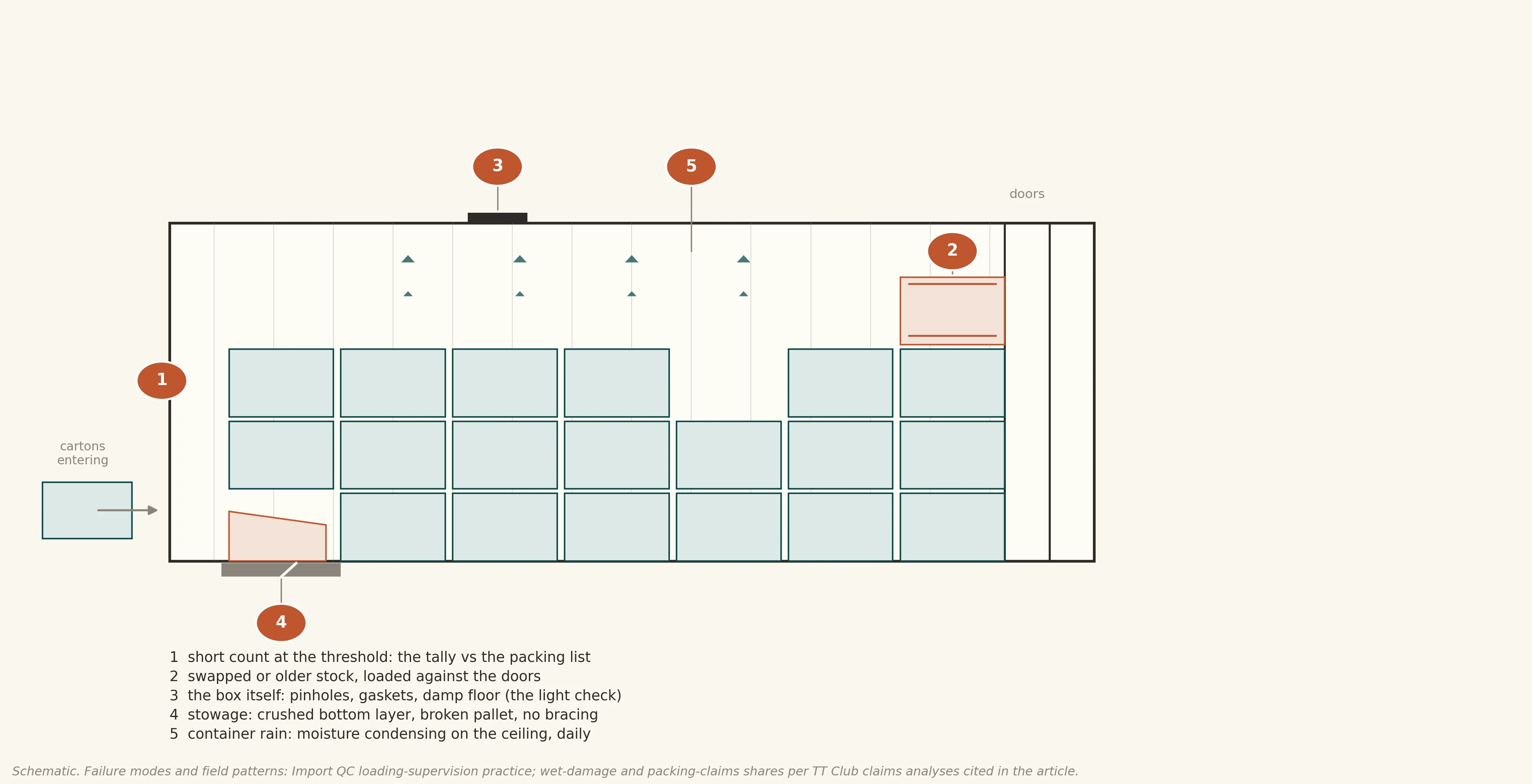
Figure 1. Five failure modes, one location. Count and swap live at the threshold, container condition lives in the box itself, stowage in the stack, moisture in the trapped air. All five close when the doors do.
3. The legal layer: what the claim is worth when it goes wrong
Buyers assume the carrier stands behind the cargo. The conventions say otherwise, and the numbers are worth reading once.
Under the US Carriage of Goods by Sea Act, the carrier's liability caps at $500 per package or customary freight unit unless a higher value is declared on the bill of lading and paid for. That $500 has not been adjusted since 1936. What counts as a "package" is the most litigated question in American maritime law: a shipment described as 480 cartons on 24 pallets can read as a $240,000 ceiling or a $12,000 one, and recent US appellate movement (the Second Circuit's 2026 line of cases, building on Hercules OEM Group v. Zim) has strengthened carrier-friendly bill-of-lading clauses that define the pallet, or even the container, as the package. Under the Hague-Visby Rules that govern most non-US trades, the cap is 666.67 SDR per package (about $900) or 2 SDR per kilogram, whichever is higher. Light, bulky, valuable cargo, the kind consumer importers ship, recovers the least under either system. A $60,000 container can carry a liability ceiling in the low thousands.
Around those caps sit three more constraints. The insufficiency-of-packing defense from section 2.4 pushes loading damage back onto the cargo side. Notice deadlines are short: three days for visible damage on ocean freight, and suit within one year under Hague-Visby. And the seal is the pivot of the whole claim: an intact seal at destination tells the carrier the loss happened outside its custody, which is why the seal photograph, taken at loading, matched to the B/L, is the single most important image in the file. The claim system does not price your cargo. It prices your evidence.
4. The un-copyable proof: what a loading watch sees
Loading supervision is the newest of the standard services, and our library skews to pre-shipment work, so the proof here is field pattern rather than report statistics. Three recurring ones.
The count that fixes itself when counted. The 5,000-becomes-4,300 case from section 2.1 is the pattern, not the exception: when an inspector tallies at the threshold, discrepancies surface in hours and resolve at the dock, because the cartons, the workers, and the paperwork are all still in the same place. The same discrepancy found at destination is a dispute; found at the dock it is a recount.
The damaged units that come back. A loading supervisor watches the rework pile. Without one, units set aside during the PSI for rework have a way of re-entering the load through the side door; our supervisors have stopped damaged cartons being re-packed into the container they were excluded from. The PSI's findings only hold if the load respects them.
The seal that ends the argument. Every CLS report closes with the seal number photographed against the door hardware, matched to the shipping documents. When a destination count comes up short against an intact photographed seal, the conversation with the supplier is short, because there is nothing left to argue about. When there is no photograph, there is no conversation either, just a claim file.
5. The method: what a supervised loading covers
A CLS booking runs in three phases, and the report lands before the truck leaves the yard.
Phase one, the empty box. The inspector checks the empty container before anything loads: watertightness (the closed-door light check), floor and wall condition, door gaskets and hardware, odor and residue from previous cargo, dryness. Desiccant poles go in per the cargo's moisture profile.
Phase two, the load. An independent tally of every carton or pallet against the packing list as it crosses the threshold; random open-carton verification against the approved sample across rows and layers; stowage watch (weight distribution, stacking orientation, dunnage and bracing, no crushed bottom layers, damaged cartons refused); carton marks and numbers matched to the shipping documents, because a count mismatch on the paperwork becomes a customs problem, not just a commercial one.
Phase three, the seal. Doors closed under observation, seal applied and photographed, seal number matched to the bill of lading, report issued. The whole record is time-stamped, so the condition of the load at gate-out is a fact rather than a recollection.
Booking guidance: supervise every full-container first order with a new supplier, every high-value load, every fragile or moisture-sensitive cargo, every consolidated mixed-SKU load, and anything loading in the pre-CNY rush, when docks are at maximum tempo and the December CLS calendar fills first. CLS composes with the PSI rather than replacing it: the PSI verifies the product, the CLS verifies that the verified product is what ships.
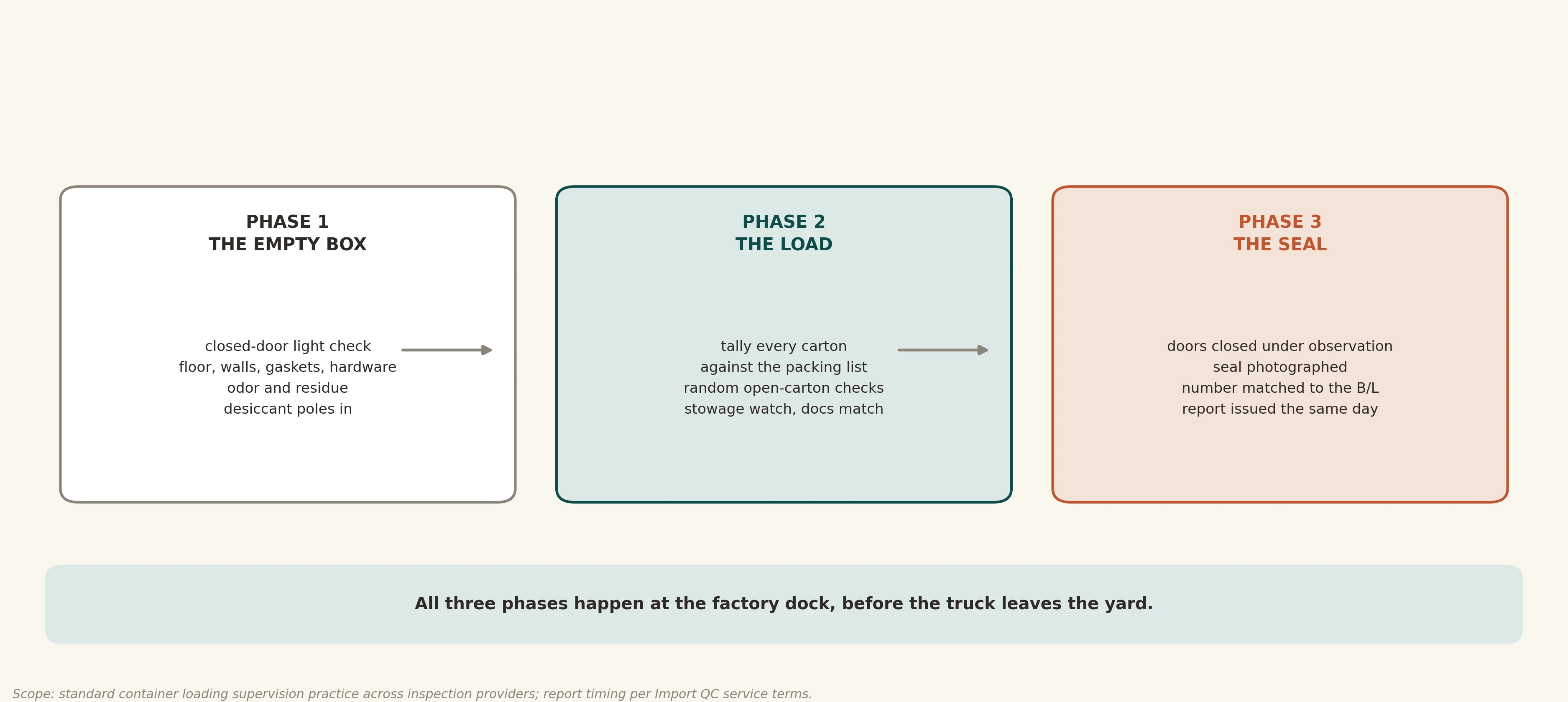
Figure 2. The supervised loading, phase by phase. Everything above happens at the factory dock, before the truck leaves the yard; the report is in your inbox the same day.
6. Fairness: when skipping CLS is reasonable
Presence costs money and the honest answer is that some loads do not need it. A mature supplier with a clean record and your own forwarder physically present at loading already has two of the three controls. Small urgent lots moving by air follow different physics. Low-value, indestructible cargo (a container of rebar does not care about stowage) buys little from supervision. And LCL is a genuinely different case: your cartons are loaded at a consolidator's warehouse, outside the factory's sight and largely outside any single inspector's control, which is precisely why the risk tables turn (more handling, more strangers), and also why supervision there is hardest to arrange. The calculus is per load: value at risk, supplier record, cargo fragility, and season. What December adds is tempo: the same factories that load carefully in June load in a hurry in the three weeks before the holiday sailings.
7. The math
A modeled load, assumptions stated: one 40HQ of consumer goods, cargo value $40,000, new supplier, second order, US West Coast destination.
Unsupervised path. The load closes unwitnessed. Applying the conservative end of the failure-mode ranges: a 2% short count ($800), or a wet-damage write-down at the industry's estimated moisture-affected share (10% of cargo value, $4,000), or a stowage collapse damaging 5% of units ($2,000). None of these needs a bad actor. Against any of them, the recovery ceiling is the legal layer: a carrier-favorable package definition caps the claim in the low thousands or at $500, the packing defense pushes stowage damage back to the cargo side, and condensation is typically excluded from insurance entirely. Realistic recovery: near zero, plus the claim file.
Supervised path. One man-day at the flat rate. The count is verified at the threshold, the cartons are opened at random, the box is light-checked, the desiccants are photographed in place, and the seal is documented. The expected loss does not go to zero (voyage risk remains, section 8), but the five failure modes that live at the dock close in one day.
The asymmetry is the same shape as every other gate in this series: a three-figure day rate against a four- or five-figure exposure, priced before the doors close rather than after they open.
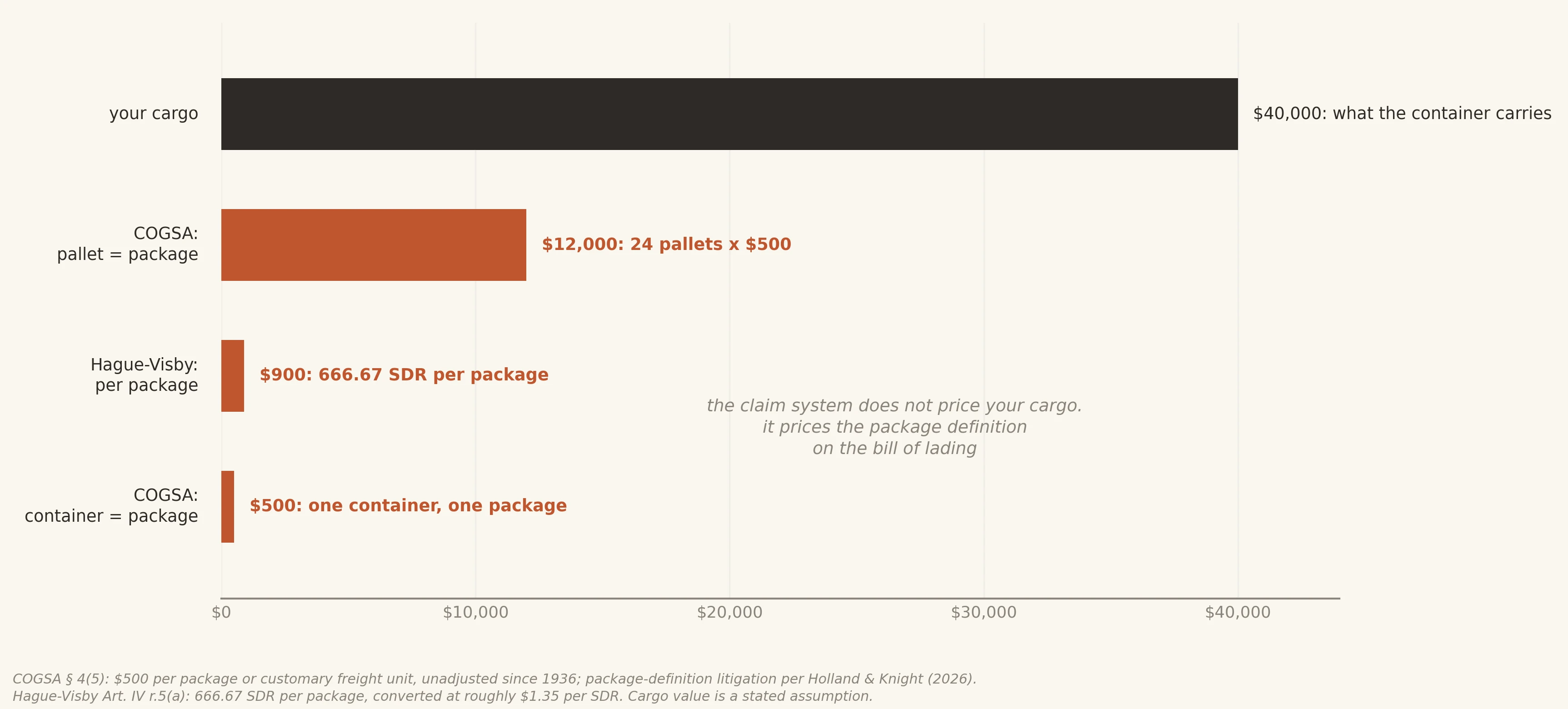
Figure 3. The recovery ceiling, not the cargo value: a $40,000 load against the liability caps of the conventions that govern it. The Hague-Visby figure converts 666.67 SDR at roughly $1.35 per SDR; the COGSA columns show the same shipment described two ways on the bill of lading.
8. Honest limits
Four. First, supervision is presence, not omniscience: the inspector tallies and samples the load, and cannot open every carton; random verification deters substitution, it does not prove a negative. Second, the watch ends at gate-out: the voyage, the ports, the crane drops, and the container yard stack are outside it, which is what cargo insurance is for. Third, a seal is evidence, not a lock: determined tampering exists, and the photograph's job is to make the tampering visible at destination, not to physically prevent it. Fourth, none of this replaces the trade-term analysis: who bears transit risk, and whether the CIF seller's minimum insurance is enough, is the Incoterms question, covered in the FOB/EXW/CIF article. CLS closes the dock. The ocean is a different contract.
FAQ
What is container loading supervision? A third-party inspector physically present while your container is loaded: empty-container condition check, independent carton tally against the packing list, random open-carton verification against the approved goods, stowage monitoring, and a photographed seal matched to the bill of lading, with the report issued before the truck leaves the yard.
What is the difference between a pre-shipment inspection and container loading supervision? The PSI samples finished goods against your specification days before shipping; it verifies the product. CLS witnesses the loading itself; it verifies that the verified product, in the full count, in a sound container, is what ships. One does not cover the other's risks, and buyers commonly book both on first and second orders.
Is container loading supervision worth it? For a full container with a new supplier, high-value, fragile, or moisture-sensitive cargo, or any December loading, the day rate is three figures against a five-figure exposure and a claims system capped at $500 per package (COGSA) or 666.67 SDR per package (Hague-Visby). For mature suppliers with your own forwarder present, the marginal value drops.
What does the inspector check in the empty container? Watertightness (the closed-door light check for holes and failed seams), floor and wall condition, door gaskets and locking hardware, odor or residue from previous cargo, and dryness. TT Club's claims analysis attributes about a quarter of wet-cargo damage to pre-existing container damage that should have been caught at this step.
Why does the seal photograph matter so much? An intact seal at destination presumptively moves the loss outside the carrier's custody, and a photographed seal number matched to the bill of lading fixes what was sealed, when, and by whom. It converts a destination shortage from an argument into a documented fact.
Will the carrier pay for damage caused by bad loading? Generally no. Insufficiency of packing is a named carrier defense under both COGSA and the Hague-Visby Rules, and TT Club estimates up to two thirds of cargo damage claims trace to poor or improper packing. Loading damage is usually the cargo side's problem, which is why the loading dock is where the evidence has to exist.
Is container rain damage covered by cargo insurance? Usually not. All-risk policies commonly exclude condensation damage as foreseeable and preventable, and carriers reject it as inherent vice or insufficient packing. Prevention at loading (sound dry container, dry pallets, desiccant poles hung and photographed) is the working control.
How much does container loading supervision cost? It is billed as a standard man-day service, same day rate as a pre-shipment inspection, typically one man-day per container load, with the report issued the same day.
Sources
- CLS scope and three-phase practice (empty-container check, supervised tally with random open-carton verification, seal and documentation control; report before the truck leaves): current practice descriptions from multiple inspection-industry providers, reviewed November 2026.
- Failure-mode taxonomy (short shipment, post-inspection substitution, mixed cargo, stowage damage, container defects, documentation mismatch as customs exposure): QCADVISOR and AmRep practitioner literature, 2026.
- COGSA: 46 U.S.C. § 30701 note, § 4(5) ($500 per package or customary freight unit unless higher value declared; unadjusted since 1936); § 4(2) excepted perils including insufficiency of packing. Package-definition litigation: Holland & Knight, "Has the U.S. COGSA Package Limitation Been Reframed?" (2026), on the Second Circuit's post-Hercules OEM Group v. Zim (S.D.N.Y. 2023) movement; 480 cartons on 24 pallets example ($240,000 versus $12,000) from that analysis.
- Hague-Visby Rules, Art. IV r.5(a): 666.67 SDR per package or 2 SDR per kilogram, whichever higher (about $900 per package at recent rates); Art. IV r.2 defenses; one-year time bar; three-day notice for visible damage: consolidated from law-firm and carrier terms sources, November 2026.
- TT Club claims analyses: up to two thirds of cargo damage claims attributable to poor or improper packing (TT Club CTU packing guidance); about 25% of 2020 wet-cargo damage from water ingress through pre-existing container damage identifiable at packing (TT Club data as reported in trade press).
- Container rain: industry estimates of about 10% of containerized goods moisture-affected to discard, wet damage at roughly 9 to 10% of shipping damage claims, 20 to 30 degree Celsius swings across climate zones, and the routine exclusion of condensation from all-risk cover as foreseeable/preventable: consolidated trade and insurance literature, 2025 to 2026. Practitioner mitigation specs (pallet moisture under 18%, six to eight calcium-chloride desiccant poles per 20-foot container, twelve to sixteen per 40HQ, light and hose tests on empty containers) from the same literature.
- Import QC field notes (anonymized): the 5,000 versus 4,300 weigh-check case; damaged units re-packed after exclusion and stopped at loading; seal photography protocol. Import QC service terms: 48 to 72 hour dispatch, same-day CLS report.
A supervised loading runs one man-day at the flat $149 rate, anywhere in China within 48 to 72 hours, and the report is in your inbox before the truck reaches the port: the count, the cartons, the box, the seal, photographed. The December calendar fills first, so book it when you book the inspection, not after.
Related reading: The pre-CNY inspection timing guide: working backward from February 6, FOB vs EXW vs CIF: which Incoterm puts inspection risk on whom, Pre-shipment inspection checklist, line by line, and the underlying documents in our sample reports library.